-
Title
-
James Burnside (1708-1755)
-
Creator
-
Burnside, James, 1708-1755
-
Publisher
-
Bethlehem Digital History Project
-
Date
-
1755
-
Type
-
Text
-
Format
-
image/jpeg
-
Description
-
A four page account of James Burnside's life detailing his early life, immigration to America, personal hardships, and increasing devotion to faith, particularly his eventual commitment to the Moravian Brethren. The narrative highlights his religious awakening, missionary work, and final moments, emphasizing his struggle with faith and ultimate peace in his belief in Christ. Written in calligraphy.
-
Subject
-
Burnside, James, 1708-1755
Moravians--Biography
Religious life--History--18th century
Biographies
-
Identifier
-
Memoirs. - BethDiary Vol. XIV, p. 749
-
Language
-
English
-
Extent
-
4 pages
-
Rights Holder
-
Moravian Archives, Bethlehem, Pennsylvania
-
transcript of
-
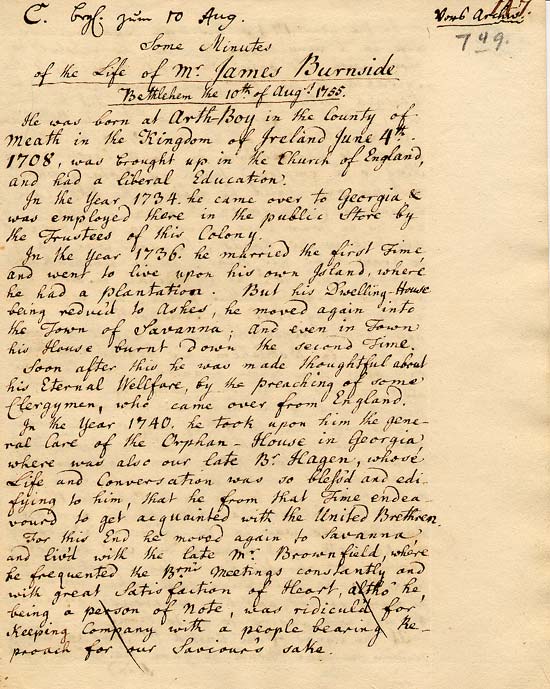
Some Minutes of the Life of Mr. James Burnside
Bethlehem the 10th of August 1755
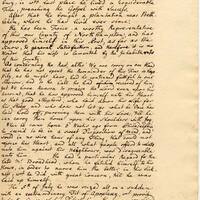
He was born at Arth Boy in the County of Meath in the kingdom of Ireland June 4th 1708, was brought up in the Church of England, and had a liberal education.
In the year 1734 he came over to Georgia and was employed there in the pubic store by the trustees of this colony.
In the year 1736, he married the first time and went to live upon his own Island, where he had a plantation. But his dwelling house being reduced to ashes, he moved again into the town of Savanna; and even in town his house burnt down the second time.
Soon after this he was made thoughtful about his eternal wellfare, by the preaching of some clergymen, who came over from England.
In the year 1740, he took upon him the general care of the Orphan-House in Georgia, where was also our late Br. [John] Hagen, whose life and conversation was so blessed and edifying to him, that he from that time endeavoured to get acquainted with the United Brethren.
For this end he moved again to Savanna, and lived with the late Mr. [John] Brownfield, where he frequented the Brethren's meetings constantly and with great satisfaction of heart, altho' he, being a person of note, was ridiculed for keeping company with a people bearing reproach for the Saviour's sake.
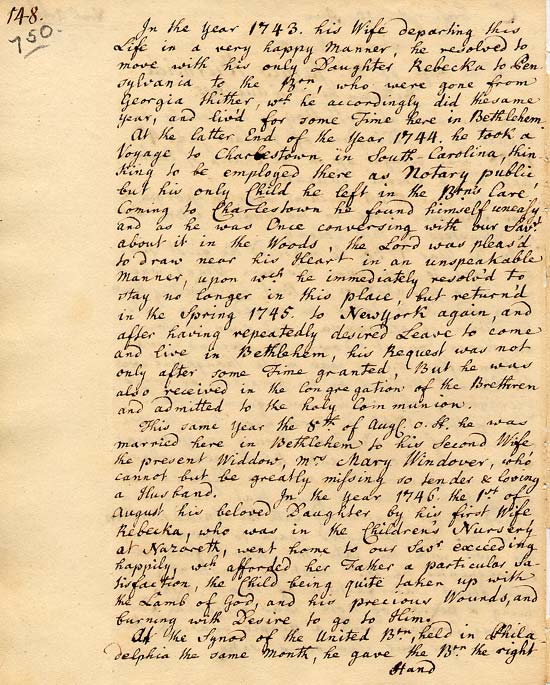
In the year 1743, his wife departing this life in a very happy manner, he resolved to move with his only daughter Rebecka to Pennsylvania to the Brethren, who were gone from Georgia thither, which he accordingly did the same year, and lived from some time here in Bethlehem.
At the latter end of the year 1744, he took a voyage to Charlestown, in South Carolina, thinking to be employed there as Notary Public but his only child he left in the Brethren's care coming to Charlestown he found himself uneasy and as he was once conversing with our Saviour about it in the woods, the Lord was pleased to draw near his heart in an unspeakable manner, upon which he immediately resolved to stay no longer in this place, but returned in the Spring 1745 to New York again, and after having repeatedly desired leave to come and live in Bethlehem, his request was not only after sometime granted, but he was also received in the congregation of the Brethren and admitted to the holy communion.
This same year the 8th of August he was married here in Bethlehem to his second wife the present widdow, Mrs. Mary Windover, who cannot but be greatly missing so tender and loving a husband. In the year 1746 the 1st of August his beloved daughter by his first wife, Rebecka, who was in the Children's Nursery at Nazareth, went home to our Saviour exceedingly happily, which afforded her father a particular satisfaction, the child being quite taken up with the Lam of God, and his precious wounds, and burning with desire to go to Him.
At the Synod of the United Brethren, held in Philadelphia the same month, he gave the Brethren the right...
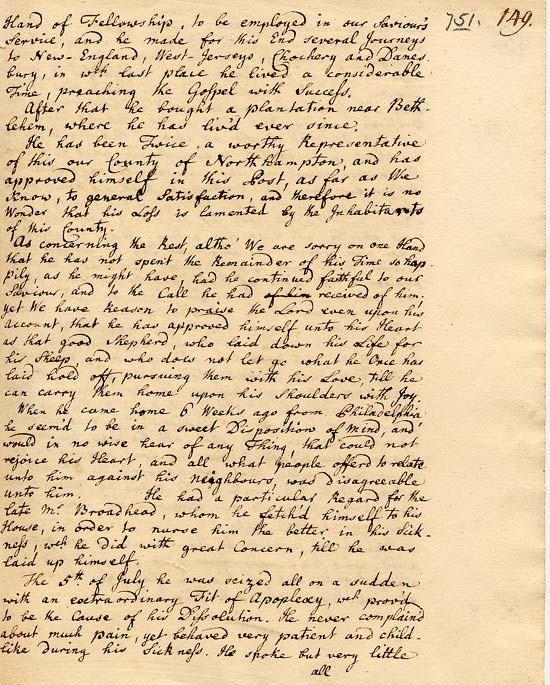
hand of fellowship, to be employed in our Saviour's service, and he made for this end several journeys to New-England, West-Jerseys, Chockery and Danesbury, in the last place he lived a considerable time, preaching the gospel with success.
After that he bought a plantation near Bethlehem, where he has lived ever since.
He has been twice a worthy representative of this county of Northhampton, and has approved himself in his post, as far as we know, to general satisfaction, and therefore it is no wonder that his loss is lamented by the inhabitants of this county.
As concerning the rest, altho' we are sorry on one hand that he has not spent the remainder of this time so happily, as he might have had he continued faithful to our Saviour, and the call he had often received of him; yet we have reason to praise the Lord even upon his account, that he has approved himself unto his heart as that good shepherd, who laid down his life for his sheep, and who does not let go what he once has laid hold oft pursuing them with his love, till he can carry them home upon his shoulders with joy.
When he came home 6 weeks ago from Philadelphia, he seemed to be in a sweet disposition of mind, and would in not wise hear of any thing, that could not rejoice his heart, and all what people offered to relate unto him against his neighbours, was disagreeable unto him. He had a particular regard for the late Mr. Broadhead, whom he fetched himself to his house, in order to nurse him the better in his sickness, which he did with great concern, till he was laid up himself.
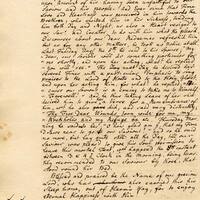
He 5th of July he was seized all on a sudden with an extraordinary fit of apoplexy, which proved to be the cause of his dissolution. He never complained about much pain, yet behaved very patient and childlike during his sickness. He spoke but very little...
all the time, his head being most affected. Yet what little he spoke was sweet, and the most remarkable and satisfactory unto us were the sinner-tears he shed upon the account of his having been unfaithful to our Saviour and his people. And ever since that time love and heartiness was perceived in him towards the Brethren, who visited him in his sickness, tending him both day and night, as also a heart resigned to our Saviour and Creator, to do with him what he pleased. Discourses bout our dear Redeemer refreshed him but as for any other matters, he took no notice at all. Last Tuesday August the 5th, he said to his spouse; "My dear, our Saviour will do something particular for me shortly," and upon her asking, what? he replied "you will see." The day next day he desired her several times with a particular emphasis to sing praises to the Lord of Hosts and to the Holy Ghost. And upon her asking him, for what? he replied, "Because our Saviour is a coming to take me to himself. Farewell!" And he thus taking leave of her she desired him to give her a verso for a remembrance of him, which he also gave did, and said very distinctly; "They five dear wounds torn wide for me, my rockholes and my refuge be etc." Thursday morning he said unto her; "O how glad am I, that my time draws near to go to our Saviour!" and so he said no more, but lay quite still all the day, till our Saviour was pleased to give his soul permission to leave this mortal tent, which happened the 9th instant between 3 and 4 o'clock in the morning, being heartily recommended to our Saviour by those that stood round his bed.
Blessed and praised be the name of our gracious Lord, who has who has also carried this his sheep home, out of harms' way, for to enjoy eternal happiness with Him!