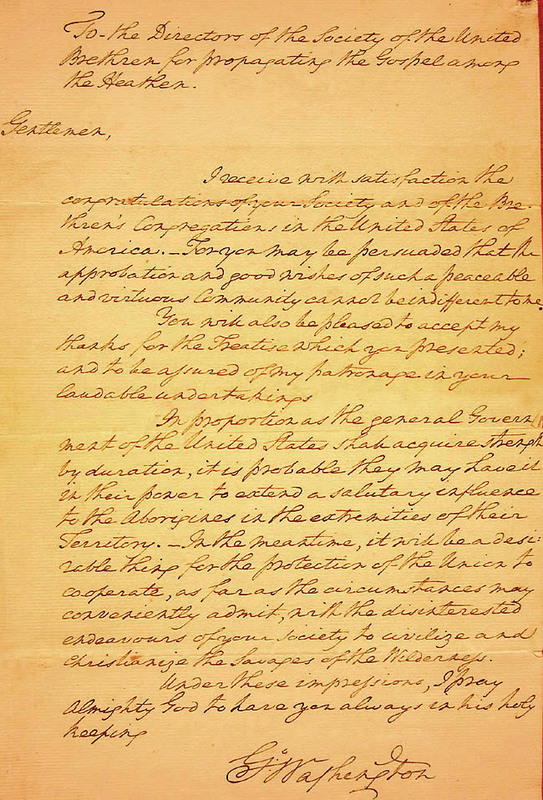
This letter is from the President of the United States George Washington (1732-1799) in reply to a letter sent by the Brethren. Washington thanks them for their congratulations and prayers. He also thanks them for the treatise on the propagation of the Gospel among the Heathen and assures them of the government's cooperation to their missionary endeavors.
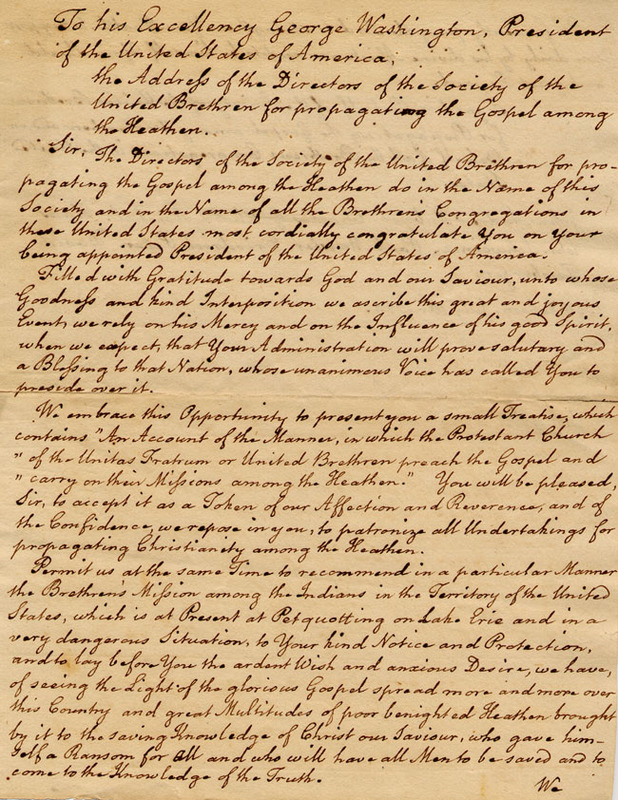
The Brethren congratulate George Washington (1732-1799) on his appointment as President of the United States, mentioning God's intervention in the process. They gift Washington with a small treatise on the propagation of the Gospel among the Heathen. They ask the President for his protection in their missionary endeavors.
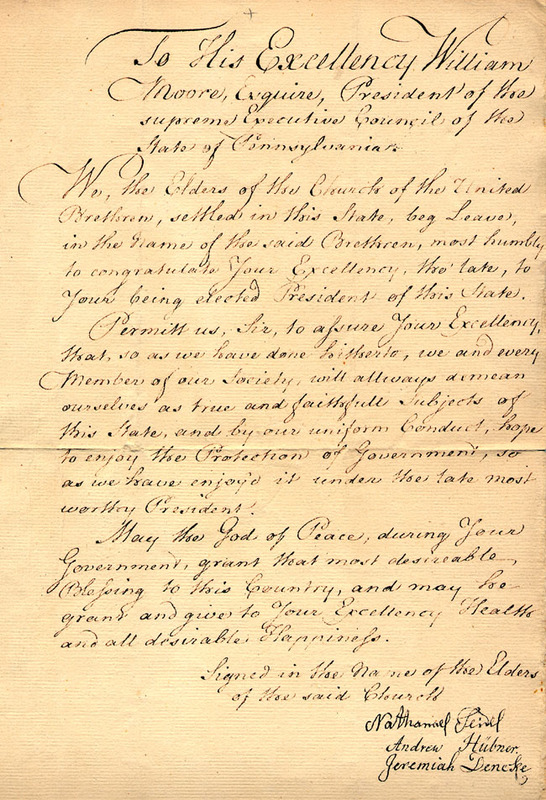
This is a letter from the Elders of the Moravian Church congratulating William Moore (1735-1793) on his election as President of the Supreme Executive Council of Pennsylvania. The Elders pledge allegiance and express their continued hopes for protection of the Brethren.
In this letter, the Indians from Philadelphia (under the protection of the Brethren) thank the Governor of Pennsylvania John Penn (1729-1795) for his hospitality and his protection.
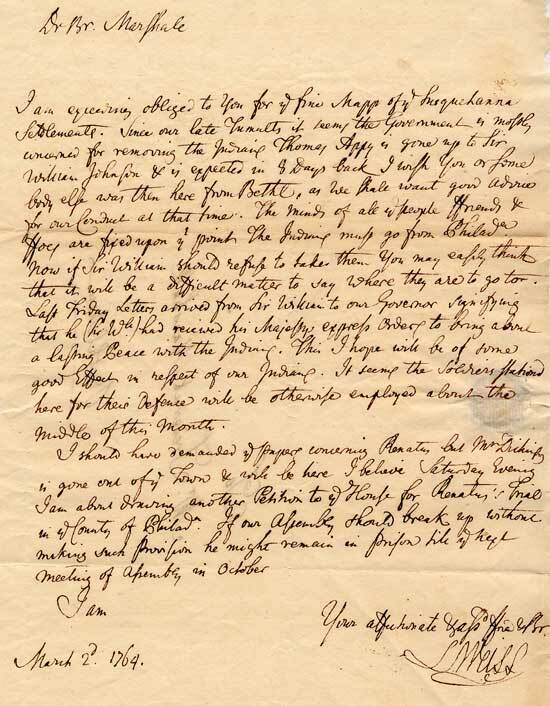
In this letter, Lewis Weiss talks about several issues that the government has with the Indians and he tells Frederick Marshall that he is not sure on what to do next.
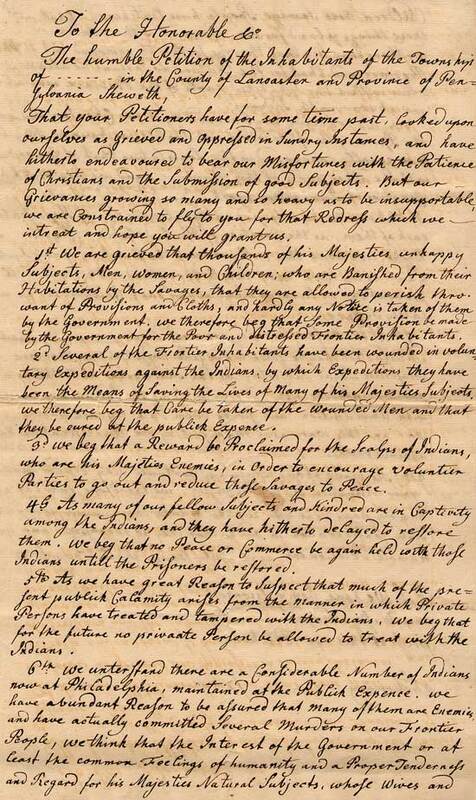
This is a petition to Governor of Pennsylvania John Penn (1729-1795) from the inhabitants of Lancaster County, Pennsylvania. They request assistance in dealing with the Indians in this time of war. They mention that the Moravian Congregation of Bethlehem has been supplying intelligence and supplies to the Indians.
William Logan sends to David Zeisberger (1721-1808), who is in New York, a copy of the message (prepared by Governor of Pennsylvania John Penn) for safekeeping and just in case the Indians need to hear it again.
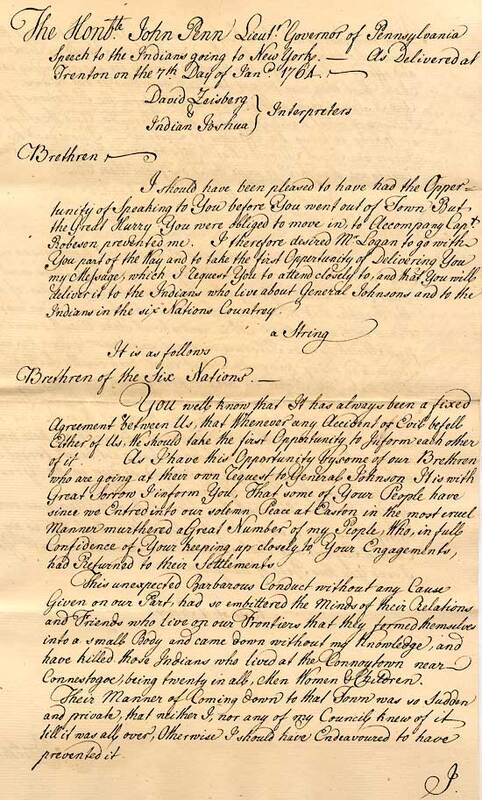
This document is a transcription of a speech prepared by Governor of Pennsylvania John Penn (1729-1795) for the Indians leaving for New York. The message was delivered by William Logan. Penn describes the sorrow and aggravation that each party feels when they kill each other. He promises justice for the Indians killed, offers protection, and proposes for both sides to "bury the hatchet".
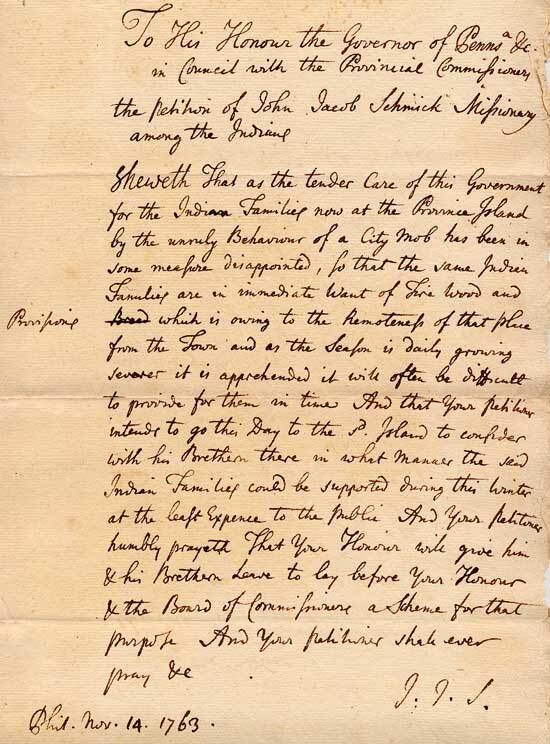
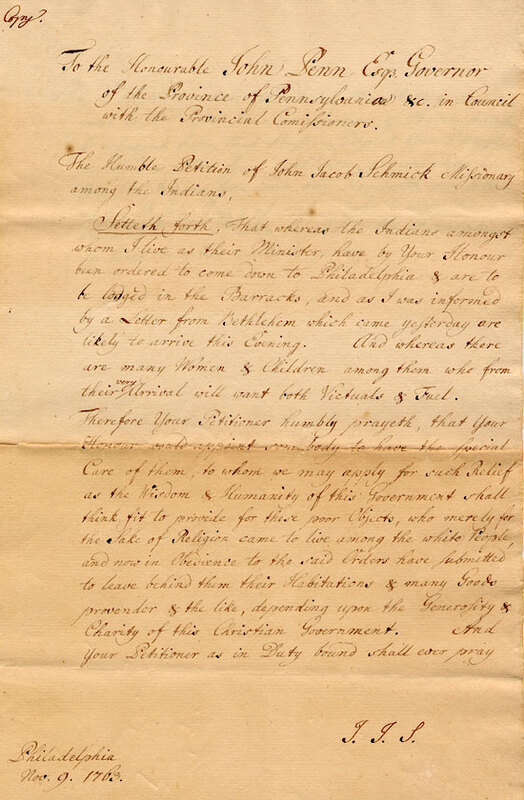
In this petition, missionary John Jacob Schmick asks Governor of Pennsylvania John Penn (1729-1795) for assistance in furnishing supplies to the Indian converts who are under the Brethren's protection.
To His Honour the Governor of Pennsa. &c. in Council with the Provincial Commisioners
The petiton of John Jacob Schmick Missionary among the Indians
Sheweth That as the tender care of this Government for the Indian Families now at the Province Island by the unruly Behaviour of a City Mob has been in some measure disappointed, so that the same Indian Families are in immediate want of fire wood and Provisions which is owing to the remoteness of that placed from the Town and as the Season is daily growing severer it is apprehended it will often be difficult to provide for them in time and that your petitioner intends to go this day to the said Island to consider with the Brethren there in what manner the said Indian Families could be supported during this Winter at the least expense to the public. And Your Petitioner humbly prayeth that Your Honour will give him & his Brethrn leave to lay before Your Honour & to the Board of Commisioners a scheme for that purpose be. And Your petitioners shall ever pray &c.
J.J.S.
Phil. Nov. 14, 1763.
Missionary John Jacob Schmick is asking John Penn (1729-1795), Governor of Pennsylvania, to show hospitality in Philadelphia to the newly arriving Indian converts.
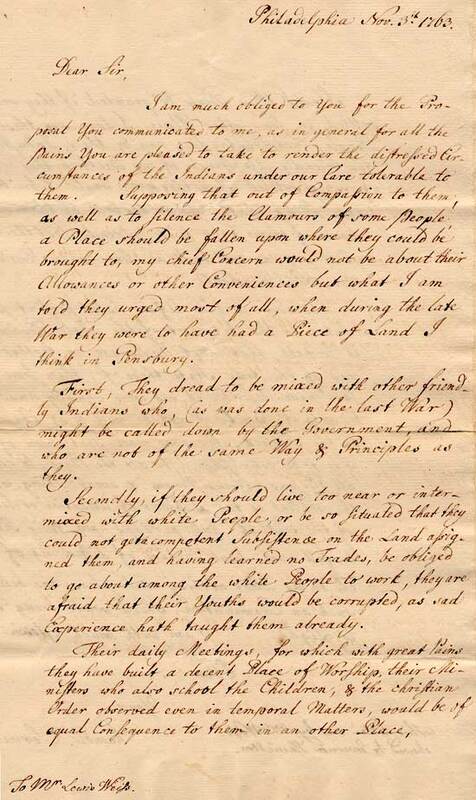
In this letter, Frederick Marshall asks Lewis Weiss for help in finding a place to settle Indian converts as they do not wish to remain living with their tribes nor do they want to settle with White Christians.
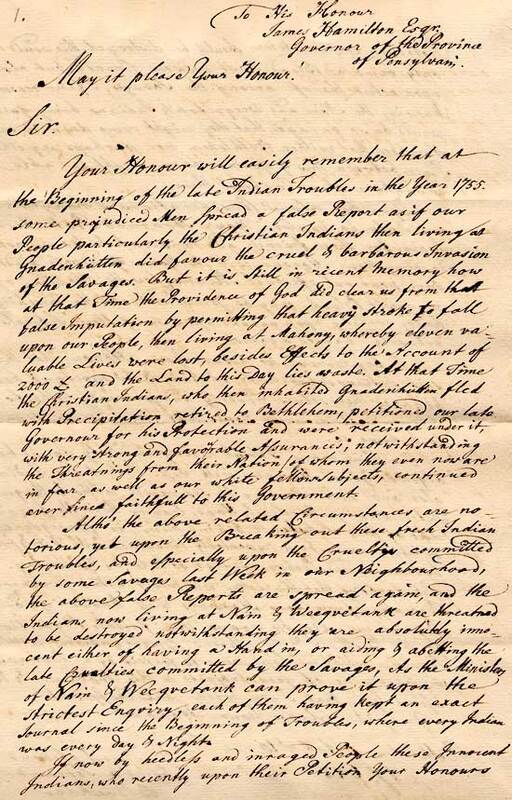
In this letter, Peter Boehler asks Governor Hamilton (1710-1783) for help to protect the Christian Indians from their own tribes but also from the White Christians. Boehler vouches for the good behavior of the Indians living at Nain and Wecquetank. He also asks the governor for protection for the Brethren in the province.
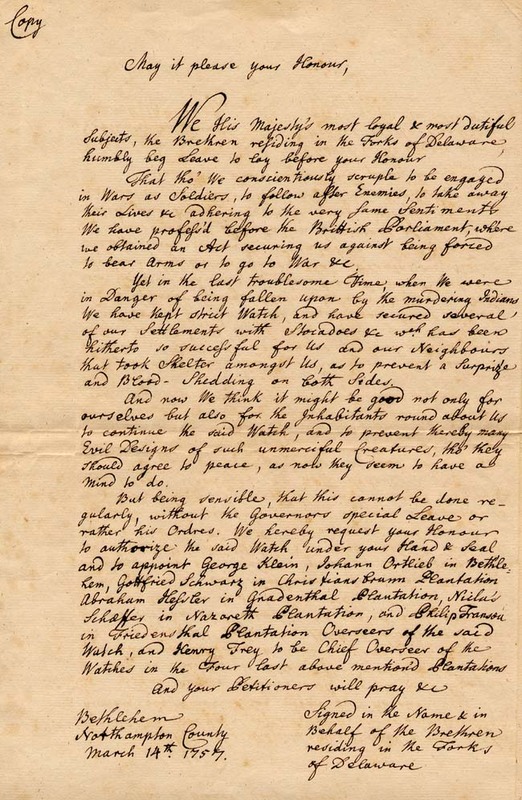
The Brethren residing at the forks of the Delaware ask William Denny (who was Governor of Pennsylvania from 1756 to 1759) for authorization and assistance in setting up a watch to protect their settlements and plantations from being attacked by Indians.
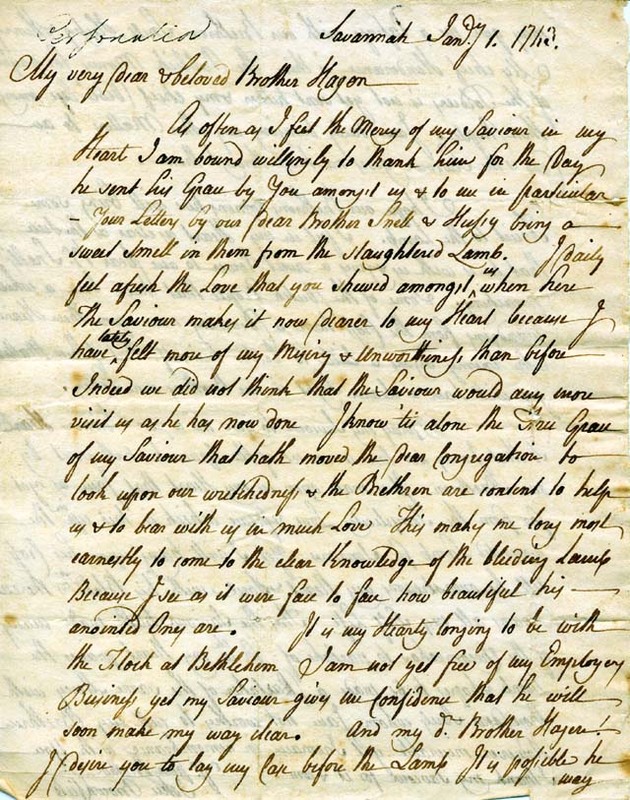
This is a letter from John Brownfield from Savannah, Georgia, to Brother Hagen of Bethlehem, Pennsylvania. It is dated January 1, 1743. Brother Brownfield humbly asks Brother Hagen for help as he would like to come back to the Bethlehem congregation.
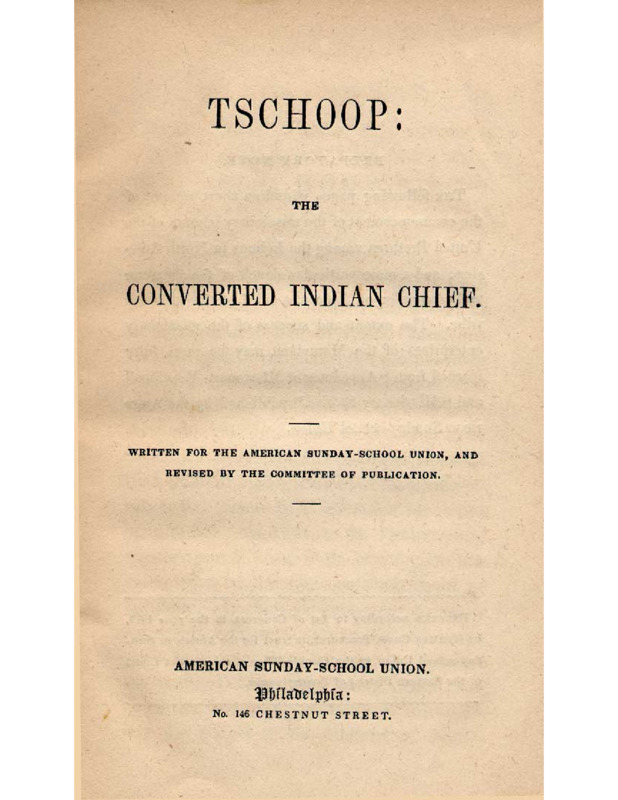
Tschoop: The Converted Indian Chief is a book written in 1842 by the American Sunday School Union. The book tells the story of Tschoop, a Native American chief who converted to Christianity in the mid-18th century. The book follows Tschoop's life, from his early days as a hunter and warrior to his conversion to Christianity and his eventual role as a missionary to his own people. The book also explores the challenges and struggles that Tschoop faced as a Christian Native American, including discrimination and mistrust from both his own people and the white settlers who were colonizing their land.
Digitized from text held by the Reeves Library, Moravian University & Theological Seminary, 2000.
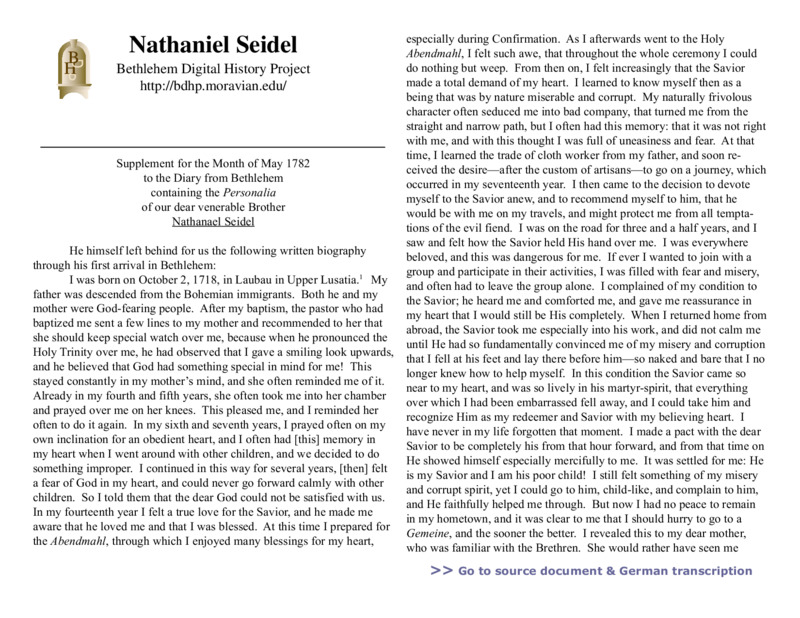
The memoir is written by Nathaniel Seidel himself up to his arrival in Bethlehem in Pennsylvania. It is continued by another brother or sister who had access to his travel diaries. Seidel recounts his childhood in Germany and the awakening he experienced at the age of 14. He rededicated himself to God at the age of 17, making a pact with his Savior. In 1739, he arrived in Herrnhut and went on to Herrnhag. In 1742, he answered a call to Bethlehem where he became the Elder of the Single Brethren. The rest of his biography recounts his many journeys among the Indians, the different settlements in North America, Europe, South America, and the West Indies. Throughout his life, he kept extensive travel diaries. He was ordained to multiple positions within the Brethren and became Bishop in 1758. The narrative accounts for his last years, his increased weakness, and his death in 1782.
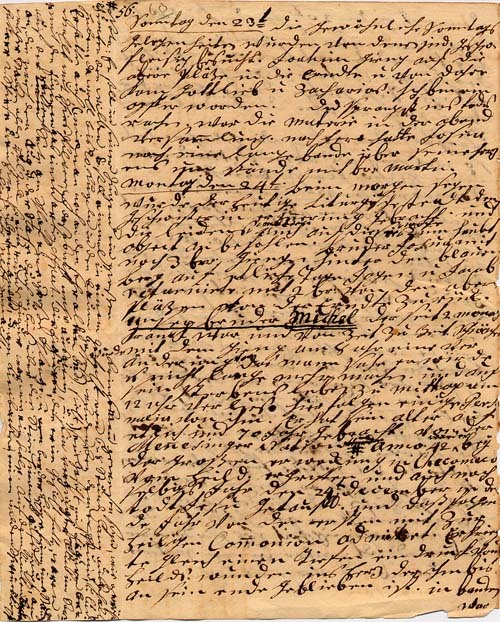
This account of Michael's life was written by another brother or sister. It recounts his upbringing in the Minisink Nation and his youth as a great warrior. The author included details about his "pleasing" facial markings. He was awakened to the Savior in 1742 and baptized. He spent several years in Gnadenhütten and then came to Bethlehem in 1755. The author describes his last illness and his death. He was remembered as a pious and holy member of the Brethren.
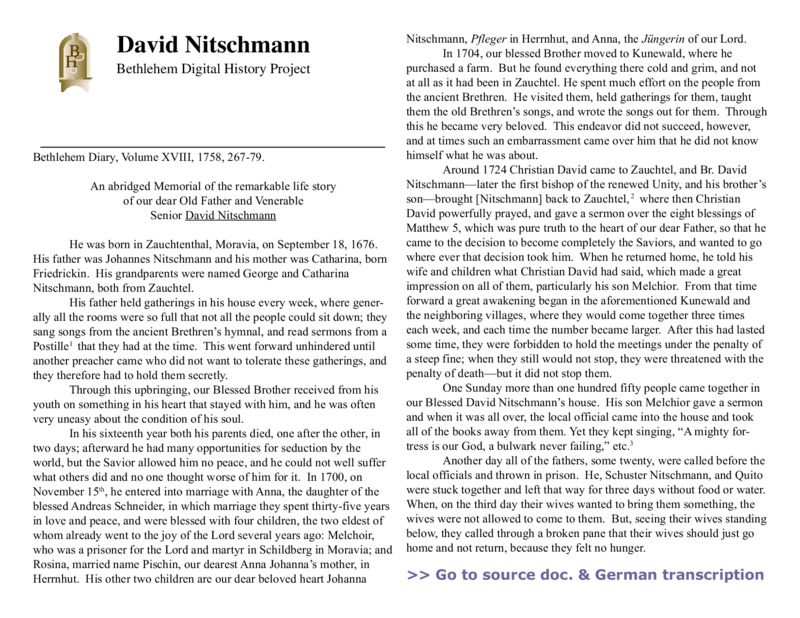
This account of David Nitschmann's life was written by another brother or sister. It recounts his childhood in Moravia and how he was raised within the secrecy of the Brethren. In 1704, he moved to Kunewald where he became a farmer. Kunewald experienced a great awakening under his leadership and several of the Brethren were taken prisoners. David himself was declared a heretic and thrown into prison. He escaped from jail and went to Berthelsdorf and then Herrnhut. He received a call to St. Thomas and to St. Croix where his wife died. He then received a call to Pennsylvania along with his daughter Anna. He was one of the builders of Bethlehem. He was a proficient writer and leader of the Widowers' Choir. The author describes in the account his last few days of illness, his death, and his funeral.
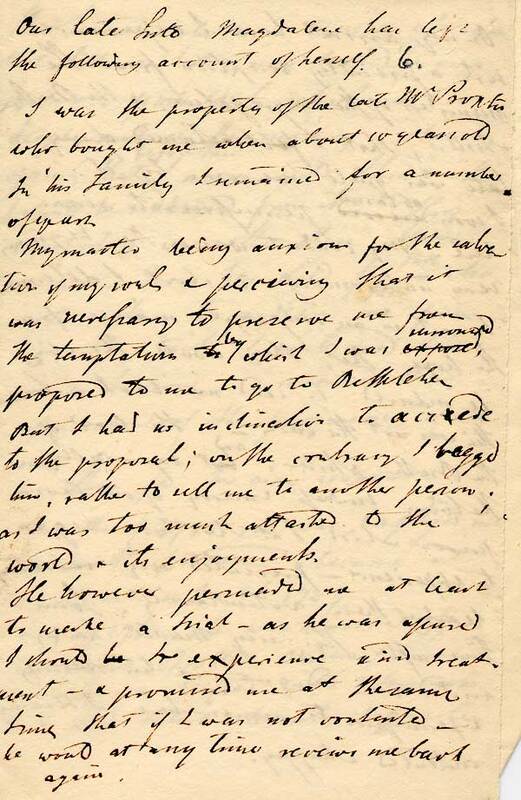
Magdalene briefly describes her childhood growing up in slavery. She was persuaded by her master to move to Bethlehem, Pennsylvania. She was reluctant at first but eventually found contentment. She received the Lord as her Savior and was baptized in 1748. The brief account was completed by another brother or sister and describes her marriage, her brief illness, and her death at the age of 89.
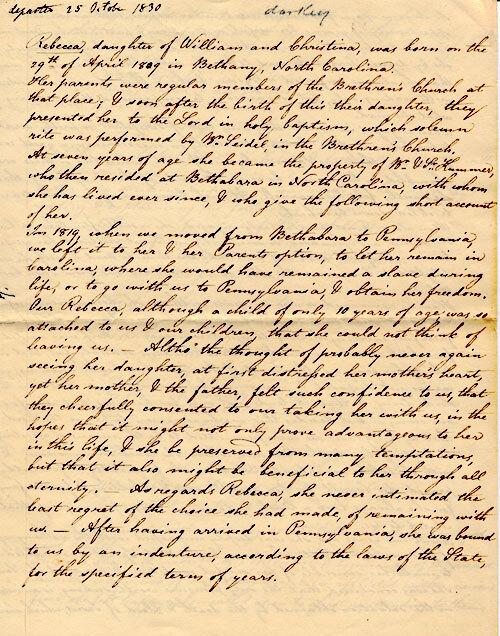
This Moravian memoir recounts the life of Rebecca, an African American young woman born in North Carolina in 1809 to parents who belonged to the Brethren’s Church. After moving with the Moravian Kummer family to Pennsylvania as a child, she was educated in the Christian faith, learned to read religious books, and became known for her gentle devotion, prayerfulness, and love of hymns about the Savior’s redeeming love. Remembered as faithful, kind, and deeply spiritual, she faced her final illness in 1830 with calm trust in Christ and died peacefully at the age of 21.
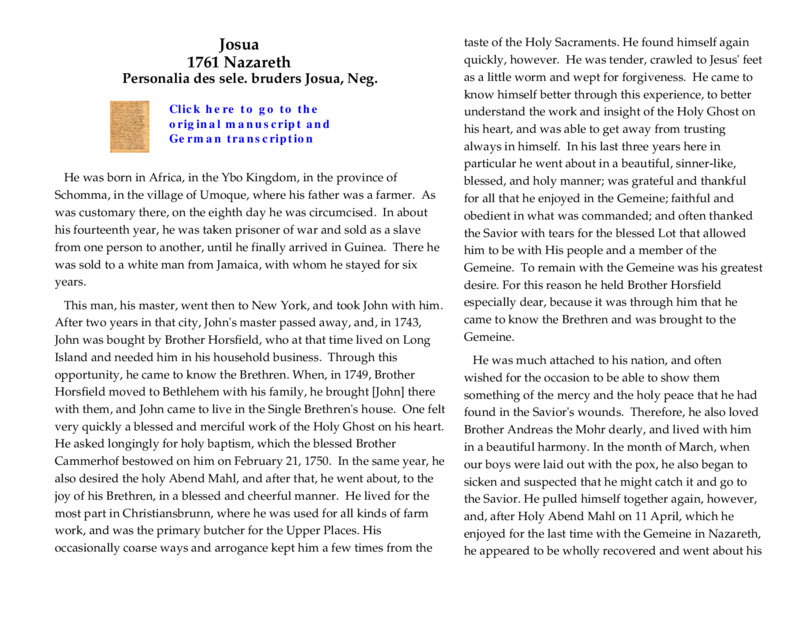
his Moravian memoir recounts the life of Josua (John), an African man from the Ybo Kingdom who was captured in war, sold into slavery, and eventually brought to New York and later Bethlehem by the Horsfield family. After encountering the Moravian Brethren, he embraced Christianity, was baptized in 1750, and became a devoted member of the Moravian congregation in Nazareth and Christiansbrunn. Remembered for his gratitude, humility, faithful work, and deep love for the Savior and the Gemeine, he died peacefully of smallpox in 1761 while expressing joy at going home to Christ.
This short biography was written by another brother or sister. The narrative recounts Thomas' birth in Germany and his arrival in America at the age of 6. He grew up in Pennsylvania, first in Philadelphia and then in Lancaster. He was very impressed and touched by a meeting with Spangenberg. He married and moved to Bethlehem in 1772 where he was well respected and loved. The account describes his very painful illness and his resignation in the Lord. There is another version of the memoir written in German in the pages preceding this account in English.
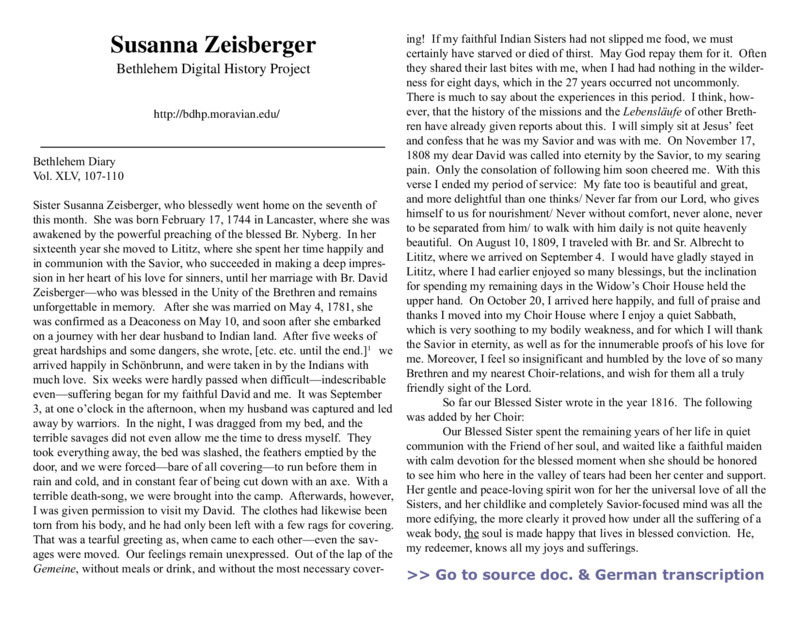
This Moravian memoir recounts the life of Susanna Zeisberger, born in Lancaster in 1744, who became a devoted member of the Moravian Church after being spiritually awakened through Moravian preaching. After marrying missionary David Zeisberger in 1781 and becoming a Deaconess, she accompanied him into Native American mission territories where they endured extreme hardships, captivity, hunger, and danger. Following her husband’s death in 1808, she spent her remaining years in the Moravian Widow’s Choir House in Bethlehem in quiet devotion to the Savior until her peaceful death at age 80.