-
Title
-
Rebecca (1809-1830)
-
Creator
-
Br. and Sr. Kummer
-
Publisher
-
Moravian Archives, Bethlehem, Pennsylvania
-
Date
-
1830
-
Type
-
Text
-
Format
-
image/jpeg
-
Description
-
This Moravian memoir recounts the life of Rebecca, an African American young woman born in North Carolina in 1809 to parents who belonged to the Brethren’s Church. After moving with the Moravian Kummer family to Pennsylvania as a child, she was educated in the Christian faith, learned to read religious books, and became known for her gentle devotion, prayerfulness, and love of hymns about the Savior’s redeeming love. Remembered as faithful, kind, and deeply spiritual, she faced her final illness in 1830 with calm trust in Christ and died peacefully at the age of 21.
-
Subject
-
Rebecca, 1809-1830
Moravians--Biography
Religious life--History--19th century
Bethlehem (Pa.)--History--19th century
Women--Biography
Biographies
-
Source
-
https://www.moravianchurcharchives.findbuch.net/php/main.php#4d656d6f6972732ex5975
-
Identifier
-
MemBeth 0719
-
Language
-
English
-
Extent
-
4 pages
-
Rights Holder
-
Moravian Archives, Bethlehem, Pennsylvania
-
transcript of
-
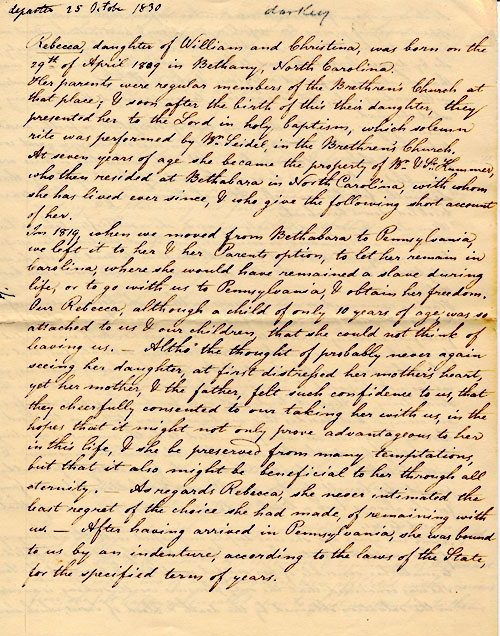
Departed 25 October 1830 darkey [written in pencil]
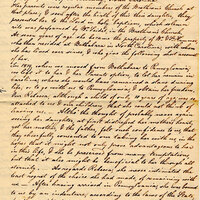
Rebecca, daughter of William and Christina, was born on the 29th of April 1809 in Bethany, North Carolina.
Her parents were regular members of the Brethren's Church at that place; and soon after the birth of this their daughter, they presented her to the Lord in holy baptism, when solemn rite was performed by Br. Seidel, in the Brethren's Church.
At seven years of age she became the property of Br. And Sr. Kummer, who then resided at Bethabara in North Carolina, with whom she has lived ever since, and who give the following short account of her.
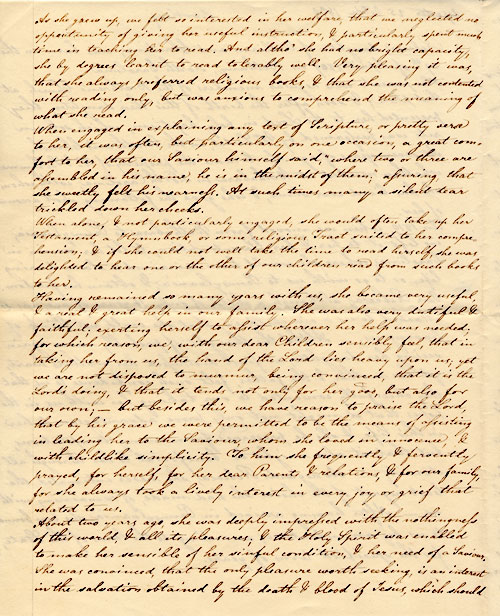
In 1819, when we moved from Bethabara to Pennsylvania, we left it to her and her parent option, to let her remain in Carolina, where she would have remained a slave during live, or to go with us to Pennsylvania, and obtain her freedom. Our Rebecca, although a child of only 10 years of age was so attached to us and our children that she could not think of leaving us. Altho' the thought of probably never again seeing her daughter, at first distressed her mother's heart, yet her mother, and the father, felt such confidence to us, that they cheerfully consented to our taking her with us, in the hopes that it might not only prove advantageous to her in this life, and she be preserved from many temptations, but that it also might be beneficial to her through all eternity. As regards Rebecca, she never intimated the least regret of the choice she had made, of remaining with us. After having arrived in Pennsylvania, she was bound to us by an indenture, according to the laws of the State for the specified term of years.As she grew up, we felt so interested in her welfare, that we neglected no opportunity of giving her useful instruction, and particularly spent much time in teaching her to read. And altho' she had no bright capacity, she by degrees learnt to read tolerably well. Very pleasing it was, that she always preferred religious books, and that she was not contented with reading only, but was anxious to comprehend the meaning of what she read.
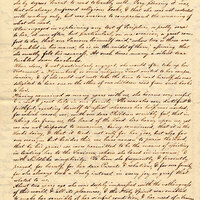
When engaged in explaining any text of Scripture, pretty verse to her, it was often, but particularly on one occasion, a great comfort to her, that our Saviour himself said, "where two or three are assembled in his name, he is in the midst of them;" assuring that she sweetly felt his nearness. At such times many a silent tear trickled down her cheeks.
When alone, and not particularly engaged, she would often take up her Testament, a hymnbook, or some religious tract suited to her comprehension; and if she could not well take the time to read herself, she was delighted to hear one or the other of our children read from such books to her.
Having remained so many years with us, she became very useful, and a real and great help in our family. She was also very dutiful and faithful; exerting herself to assist wherever her help was needed; for which reason, we, with our dear Children sensibly feel, that in taking her from us, the hand of the Lord lies heavy upon us; yet we are not disposed to murmur, being convinced, that it is the Lord's doing, and that it tends not only for her good, but also for our own; but besides this, we have reason to praise the Lord, that by his grace we were permitted to be the means of assisting in leading her to the Saviour, whom she loved in innocence, and with childlike simplicity. To him she frequently and fervently prayed for herself, for her dear parents and relations, and for our family, for she always took a lively interest in every joy or grief that related to us.
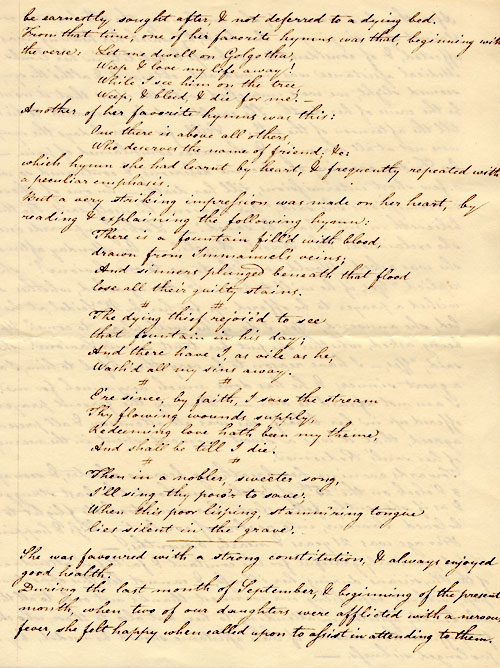
About two years, she was deeply impressed with the nothingness of this world, and all its pleasures; and the Holy Spirit was enabled to make her sensible of her sinful condition, and her need of a Saviour. She was convinced, that the only pleasure worth seeking, is an interest in salvation obtained by the death and blood of Jesus, which should be earnestly sought after, and not deferred to a dying bed.
From that time, one of her favorite hymns was that, being with the verse: Let me dwell on Golgotha,
Weep and love my life away!
While I see him on the tree
Weep, and bleed, and die for me.
Another of her favorite hymns was this:
One there is above all others,
Who deserves the name of friend; etc.
Which hymn she had learnt by heart, and frequently repeated with a peculiar emphasis.
But a very striking impression was made on her hears, by reading and explaining the following hymn:
There is a fountain filled with blood,
Drawn from Immanuel's veins;
And sinners plunged beneath that flood
Lose all their guilty stains.
# #
The dying thief rejoiced to see
That fountain in his day;
And there have I as vile as he,
Wash'd all my sins away.
# #
E're since, by faith, I saw the stream
Thy flowing wounds supply,
Redeeming love had been my theme,
And shall be till I die.
# #
then in a nobler, sweeter song,
I'll sing they pow'r to save;
When this poor lisping, stamm'ring tongue
Lies silent in the grave.
She was favoured with a strong constitution, and always enjoyed good health.
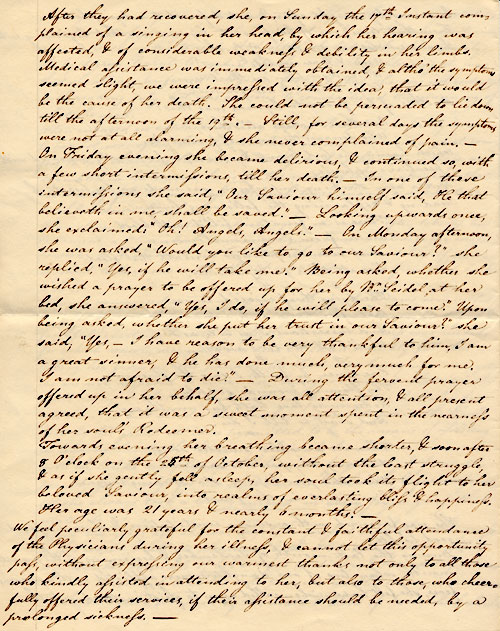
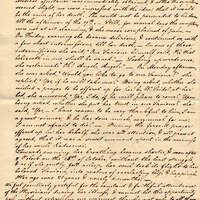
During the last month of September, and beginning of the present month, when two of our daughters were afflicted with a nervous fever, she felt happy when called upon to assist in attending them.After they recovered, she, on Sunday the 17th instant complained of singing in her head, by which her hearing was affected, and of considerable weakness and debility in her limbs. Medical assistance was immediately obtained, and altho' the symptoms seemed slight, we were impressed with the idea, that it would be the cause of her death. She could not be persuaded to lie down till the afternoon of the 19th. Still, for several days the symptoms were not at all alarming, and she never complained of pain.
On Friday evening she became delirious, and continued so, with a few short intermissions, till her death. In one of these intermissions she said, "Our Saviour himself said, He that believeth in me shall be saved." Looking upwards once, she exclaimed: "Oh! Angels, Angels." On Monday afternoon, she was asked, "Would you like to go to our Saviours?" she replied, "Yes, if he will take me." Being asked whether she wished a prayer to be offered up for her by Br. Seidel, at her bed, she answered, "Yes, Id do, if he will please to come." Upon being asked, whether she put her trust in our Saviour?" she said, "yes, I have reason to be very thankful to him, I am a great sinner, and he had done much, very much for me. I am not afraid to die." During the fervent prayer offered up in her behalf, she was all attention, and all present agreed that it was a sweet moment spent in the nearness of her soul's Redeemer.
Towards evening her breathing became shorter, and soon after 8 O'clock on the 25th of October, without the least struggle, and as if she gently fell asleep, her would took its flight to her beloved Saviour, into reams of everlasting bliss and happiness. Her age was 21 years and nearly 6 months.
We fell peculiarly grateful for the constant and faithful attendance of the Physicians during her illness, and cannot let this opportunity passe, without expressing our warmest thanks not only to all those who kindly assisted in attending to her, but also the those, who cheerfully offered their services, if their assistance should be needed, by a prolonged sickness.