-
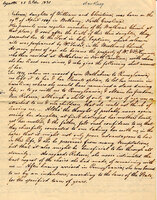 Rebecca (1809-1830)
 This Moravian memoir recounts the life of Rebecca, an African American young woman born in North Carolina in 1809 to parents who belonged to the Brethren’s Church. After moving with the Moravian Kummer family to Pennsylvania as a child, she was educated in the Christian faith, learned to read religious books, and became known for her gentle devotion, prayerfulness, and love of hymns about the Savior’s redeeming love. Remembered as faithful, kind, and deeply spiritual, she faced her final illness in 1830 with calm trust in Christ and died peacefully at the age of 21.
-
 Josua (1720-1761)
 his Moravian memoir recounts the life of Josua (John), an African man from the Ybo Kingdom who was captured in war, sold into slavery, and eventually brought to New York and later Bethlehem by the Horsfield family. After encountering the Moravian Brethren, he embraced Christianity, was baptized in 1750, and became a devoted member of the Moravian congregation in Nazareth and Christiansbrunn. Remembered for his gratitude, humility, faithful work, and deep love for the Savior and the Gemeine, he died peacefully of smallpox in 1761 while expressing joy at going home to Christ.
-
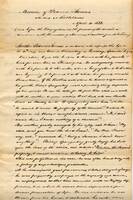 Johann Francis (Frantz) (Franz) Thomas (1732-1822)
 This short biography was written by another brother or sister. The narrative recounts Thomas' birth in Germany and his arrival in America at the age of 6. He grew up in Pennsylvania, first in Philadelphia and then in Lancaster. He was very impressed and touched by a meeting with Spangenberg. He married and moved to Bethlehem in 1772 where he was well respected and loved. The account describes his very painful illness and his resignation in the Lord. There is another version of the memoir written in German in the pages preceding this account in English.
-
 Susanna Zeisberger (1744-1824)
 This Moravian memoir recounts the life of Susanna Zeisberger, born in Lancaster in 1744, who became a devoted member of the Moravian Church after being spiritually awakened through Moravian preaching. After marrying missionary David Zeisberger in 1781 and becoming a Deaconess, she accompanied him into Native American mission territories where they endured extreme hardships, captivity, hunger, and danger. Following her husband’s death in 1808, she spent her remaining years in the Moravian Widow’s Choir House in Bethlehem in quiet devotion to the Savior until her peaceful death at age 80.
-
 Marie (Maria) Werner (1711-1760)
 This biography was written by another brother or sister. It recounts Marie's birth in Austria and how she was first raised as a Catholic and then a Lutheran. She then moved to Augsburg where she became acquainted with the Brethren. She felt a call to the Gemeine and moved to Herrnhag in 1740. She arrived in Bethlehem in 1742 where she married and worked in the nursery. The author describes Marie's very long and painful illness as well as her unwavering faith until her death.
-
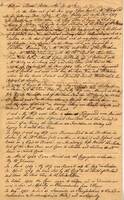 William Thorne (1726-1757)
 This short biography was written by another brother or sister. It recounts Thorne's upbringing in the Church of England. Thorne was dissatisfied and left school to follow Wesley. He was then invited by the Brethren in London who sent him to North Ireland for a few years. In 1755, he left for America and died in Bethlehem. The narrative lists all of his children.
-
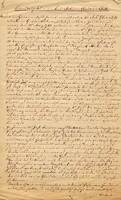 John (Johann) Christian Till (1762-1844)
 In this biography written by another brother or sister (but which includes some of his own words), the author recounts his childhood in Pennsylvania, his strict education, and his particular talent for music. During the Revolutionary War in Bethlehem, he fell into a "licentious state" that resolved after the war. He became a tradesman and a teacher of music. He spent a few years in Hope, New Jersey, and came back to Bethlehem in 1808 to be an organist and a teacher. The author recounts his last years in Bethlehem as well as his final illness.
-
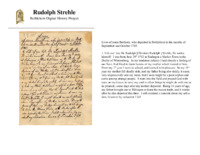 Rudolph Strehle (1712-1785)
 This Moravian memoir recounts the life of Rudolph Strehle, born in Württemberg in 1712, who experienced a long spiritual struggle during his years as a soldier before finding peace through the Moravian Brethren and devotion to Christ’s suffering and grace. After formally joining the Moravian congregation in Germany in 1745, he immigrated to Bethlehem, Pennsylvania, where he worked faithfully as a mason and served the community in various roles, especially as a trusted night watchman during the Indian War years. Remembered for his deep faith, scriptural knowledge, humility, and joyful devotion to the Savior, he died peacefully in 1785 in his 74th year.
-
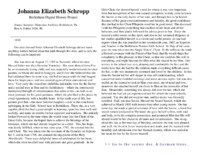 Johanna Elizabeth Schropp (1785-1810)
 The account was written by one of Johanna's brother or sister but contains many of her own words from her personal papers. She was raised in Bethlehem first in the Girls' Choir and then in the Single Sisters' Choir. She was a teacher. She was very close to God and always acted with humility and submission. She relied on God for everything. The biography describes her devotion and her unlimited trust in God. The account also describes her illness and her death at the age of 24.
-
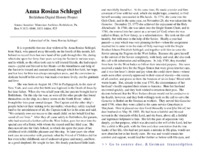 Anna Rosina Schlegel (1761-1831)
 This biography of Anna Rosina Schlegel was written by one of her fellow brother or sister. It recounts her childhood in Bethlehem while her parents were missionaries in the West Indies. She herself went to the West Indies with her husband and then returned to America where her husband died. She always felt that she was led by God and that she was called to follow his plan. She became a teacher in Bethlehem and then entered the Widows' House where she spent her last years.
-
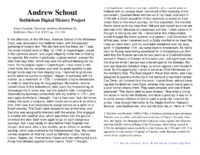 Andrew Schout (1700-1763)
 This memoir by Andrew Schout describes his childhood in Copenhagen and his upbringing as a pious Lutheran. He became a merchant and then a sailor and traveled throughout the world. He had a conversion experience on one of his journeys. He met the Brethren in Amsterdam. The memoir ends in 1746 and another brother or sister completed it by recounting his multiple trips on the Irene with Garrison and the last years of his life in Bethlehem.
-
 Mary Elizabeth Ross (1806-1822)
 This short biography of Mary Elizabeth Ross was written by another brother or sister. It succinctly recounts her upbringing in Bethlehem and it describes her illness and her death at the age of 15.
-
 Peter Rose (1733-1814)
 Rose's memoir was written by a brother in Bethlehem. Rose was raised as a Lutheran in Germany. He had an inclination to come to America since childhood. He arrived in Baltimore in 1758 and worked as a farmer in Maryland. He then became a soldier during the war. He was injured and deserted. He requested permission to stay in Bethlehem, it was first denied and then granted. He experienced an awakening on Good Friday 1765. After a short stay in Salem, North Carolina, he returned to Bethlehem with his wife where he spent his last years.
-
 Joseph Rice (1785-1831)
 This Moravian memoir recounts the life of Joseph Rice, born in Nazareth in 1785, who spent his life working in Moravian communities as a hat maker, tavern keeper, and brewer. Married in 1808 to Anne Salome Heckewelder in Gnadenhütten, he became known for his willingness to serve and skill in business, though the memoir also reflects on personal struggles that affected his health and spiritual life. During his final illness in 1831, he underwent a period of deep self-examination, renewed trust in Christ’s mercy, and constant prayer before dying peacefully at age 46 surrounded by his family in Bethlehem.
-
 John (Johann) Frederick (Friedrich) Peter (1746-1813)
 In his memoir, Johann Friedrich Peter describes his childhood in Holland and in Niesky. He attended the seminary in Barby and joined the Single Brothers' Choir in 1770. In 1779, he was called to Salem, North Carolina. He then served in several congregations like Graceham, Maryland, and Hope, New Jersey. Peter's memoir ends in 1792. Another brother or sister finished it by recounting his last years in Bethlehem where he served with "exemplary faithfulness".
-
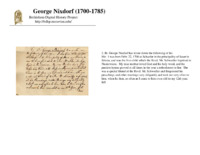 George Nixdorf (1700-1785)
 In this memoir, George Nixdorf describes his birth and childhood in Silesia. He was raised by a very pious mother and he remembers the awakening of the children of Silesia in 1708. Later in his life, he met Moravians (including Christian David) in a tavern where he was working. After a much troubled life, he arrived in Herrnhut in 1742. The following year, he and his wife traveled to Pennsylvania serving multiple congregations including Lancaster. The memoir was finished by another brother or sister who describes Nixdorf's unwavering faith and recounts his last years.
-
 George Neisser (1715-1784)
 The author of this short biography wrote this account of George Niesser's life towards the end of the 19th century. He recounts his birth in Germany then his journeys to first Georgia and then Pennsylvania. He was the pastor of various congregations including Philadelphia where he died in 1784.
-
 Elizabeth Lewis (1743-1831)
 In this memoir, Elizabeth Lewis recounts her childhood in England and her awakening when she entered the Sisters' House. She ardently describes her deep faith and the comfort that she finds in her Savior. In 1767, she moved to Herrnhut where she learned German. In 1783, she answered a call to join the Sisters' Choir in Bethlehem, Pennsylvania. The memoir was finished by another brother of sister who describes her health issues and her last years in Bethlehem.
-
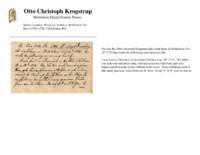 Otto Christoph (Christian) Krogstrup (1714-1785)
 In this memoir, Otto Christoph (Christian) Krogstrup recounts his birth and pious childhood in Denmark as well as his awakening during his higher education. He also describes his "spiritual birth" as an adult. He was ordained and served congregations in Denmark. But he was dismissed because he wouldn't grant absolution to people who came to him for confession. After 1748, he traveled through Herrnhut, Marienborn, Herrnhag, and Barby. He left in 1753 for America where he served several Moravian congregations. Another brother or sister finishes the memoir recounting his faithful heart and the last years of his ministry and the state of his declining health. Written in calligraphy.
-
 Catherine (Catharina) Huber (1703-1798)
 This memoir written by Catherine's daughter recounts Catherine's difficult childhood as she was raised by a conservative Catholic father and a pious (Protestant) mother. Both had to hide their faith and their spiritual longings. Catherine ran away from home in 1725 and moved to Herrnhut where her mother eventually joined her. She and her first husband were called to Georgia where she played an active role in the mission to the Indians. After meeting with Count Zinzendorf, she moved to Bethlehem, Pennsylvania, where she married for a third time. She became a widow again and spent the rest of her life between Nazareth and Bethlehem, faithfully answering the communities' calls. Written in German calligraphy.
-
 Elizabeth Horsfield (1754-1836)
 Elizabeth's children describe her Huguenot family ancestry and how they escaped France to finally arrive in Philadelphia, Pennsylvania. Her family was acquainted with Brother Spangenberg and Count Zinzendorf. Elizabeth received a liberal education in Philadelphia and moved to Bethlehem, Pennsylvania when she was 21, a Moravian community in which she spent the rest of her life. Her children mentioned that she suffered from "nervous affections" and forgetfulness but she never lost her love for her Savior.
-
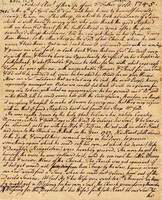 Johann Gold (1678-1745)
 This memoir is written in calligraphy by another brother or sister upon Johann Gold's death. It recounts his childhood in Moravia and then Herrnhut as well as his call by the Moravian Church to St. Thomas. The narrator recounts that, for a very long time, Gold was a "bitter enemy" of the Moravian Church. Eventually, the love of the Lord overwhelmed Gold and it took over his life as a missionary.
-
 Nicholas Garrison (1701-1781)
 In his memoir, Nicholas Garrison describes his early years as well as his early experience as a sailor when he was overtaken by sin and lived only an "outward appearance of piety." In his life, he met with prominent Moravians like Brothers Spangenberg and Count Zinzendorf. He recounts his conversion experience as he got close to the Brethren. He also narrates his experience as a prisoner and how he enjoyed the Lord's protection amid the difficult experiences. Garrison was the captain of the Irene that transported Moravian missionaries to and from Europe to America and the Eastern West Indies. He ended his life in Bethlehem, Pennsylvania. Another brother or sister finished his memoir recounting his last days and remembering his service to the Lord.
-
 John Ettwein (1721-1802)
 John Ettwein's memoir in which he recounts his ancestry, his religious education, his pious childhood, and his conversion experience as a teenager. He talks about his experience in Hernnhut during the Sifting Time. He recounts his travels throughout Germany and England and his call to America in 1754. He talks about his "pilgrimage" throughout his missionary work in 12 states. He highlights his pious devotion and the Lord's protection throughout his life. The memoir is completed by another brother or sister who recounts the last years of his life. Written in German calligraphy.
-
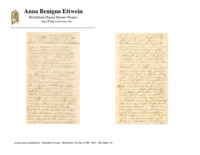 Anna Benigna Ettwein (1749-1834)
 Memoirs of Anna Banigna Ettwein (1749-1834) describing her childhood in Germany, her conversion experience as a child, her faith as it was tested by hardships, and her relocation to Bethlehem, PA. The last part of the memoir was added by another contributor describing her illness and her faith in times of struggle.