Instruments
Most Common Instruments Used
Brass
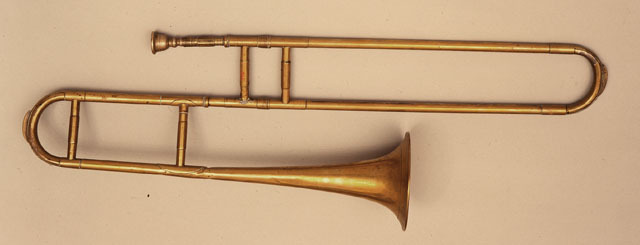
Alto Trombone
Trombones were used in military bands and by composers throughout the 18th century in Europe, but it was the Moravians who brought the idea to the American colonies. Records from Bethlehem in 1754 mention the first use of trombone choirs, and the Bethlehem Moravians owned the only set of trombones in the colonies until 1765. Trombones did not accompany singing inside the church. Rather, they were used outside, to announce a worship service from the church belfry, or an outdoor balcony.
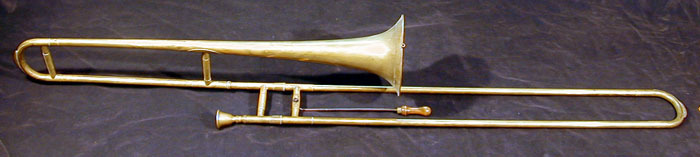
Bass Trombone
E flat bass trombone marked "G.W. Voight, Jr. Markneukirchen Sachsen". Made of brass with nickel silver mounts, 54 1⁄4” long, 10” bell. The handle attached to the slide of this trombone, allowed the player to extend the slide farther than an arm could reach to create low notes. Dates made is unknown. From the collection of the Moravian Historical Society, Nazareth, Pennsylvania.
Strings

Cittern
This cittern has 12 strings (6 double courses) a carved head, peg box grated into its neck, and “Juliana D Bader” inscribed in the back of the peg box. Juliana Bader was a single sister in Nazareth and received the cittern from her father, Philip Christian Bader who came to Pennsylvania from Germany in 1751. The cittern is a wire-strung, plucked instrument in the lute/guitar family, popular in Europe during the sixteenth and seventeenth centuries.
Made in Germany of curly maple. From the collection of the Moravian Historical Society, Nazareth, Pennsylvania.
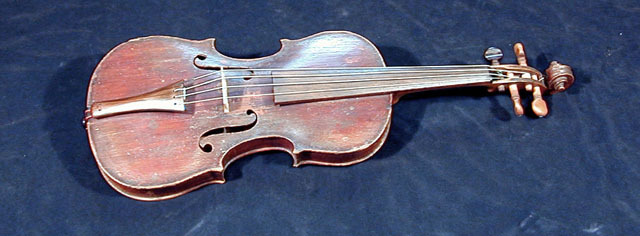
Violin
This is the earliest known extant American violin. It was made by the versatile, American-born, John Antes (1740-1811) in Bethlehem, Pennsylvania. It shows characteristics of Saxon violins of which he was familiar. With no master instrument maker to train him, Antes copied what he saw and improved his trade through ingenuity and necessity. In addition to being America’s first luthier, Antes was also a composer and a Moravian missionary.
Raised in Moravian schools, Antes showed early promise as a musician, and also as an instrument maker. The only known Antes instruments which survive, however, are this violin made in 1759, and a viola made in 1764 (now in the collection of the Lititz Moravian Archives). A cello which he made in 1764 is thought to be in the Moravian Church collection in Gnadenhutten, Ohio. Antes was contracted to make a set of instruments for Lititz, Pennsylvania. The only known Antes instruments which survive, however, are this violin made in 1759, and a viola made in 1764 (now in the collection of the Lititz Moravian Archives). A cello which he made in 1764 is thought to be in the Moravian Church collection in Gnadenhutten, Ohio.
This piece, made of maple, walnut, and ebony
was restored by C.F Martin & Co., 1954, and by the Smithsonian Institute, 1967.
Wind
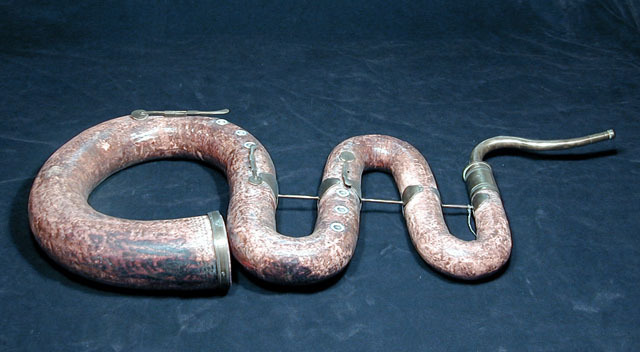
Serpent
This forerunner of a tuba is made of two pieces of wood, hollowed out, bent, glued together, and covered in leather. The brass rods which connect the coils indicate a “marching” version rather than a “concert” version, which has no connecting rods. Pitched at C, this serpent played a bass note. Serpents have been played in Europe dating back to the 16th century.
Construction materials include pearwood, leather, brass, and ivory. From the collection of the Moravian Historical Society, Nazareth, Pennsylvania.
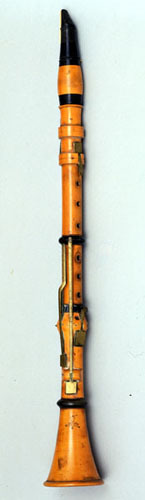
Clarinet
Clarinet made by Heinrich Gottlieb Gütter, c. 1820-47, in Bethlehem, Pa. This clarinet made of boxwood has ebony bands and brass trim. It is stamped "Gutter Bethlehem," with an eagle trefoil. It is pitched in C, which is stamped on each joint. From the collection of the Moravian Historical Society, Nazareth, Pennsylvania.
Percussion
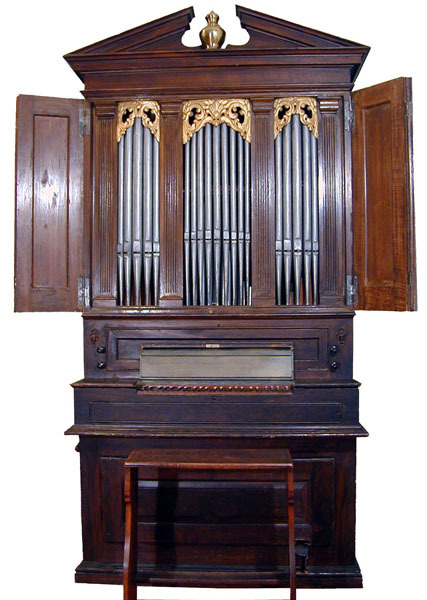
Organ
This instrument was made by David Tannenberg in Lititz, Pennsylvania for the chapel of the Single Brothers' House, Bethlehem, Pennsylvania. David Tannenberg has been called the most important organ builder in 18th century America. He lived and worked in the Moravian communities of Bethlehem, Nazareth and Lititz, and he built organs for Moravian, Lutheran and Reformed congregations. Nine Tannenberg organs still survive.
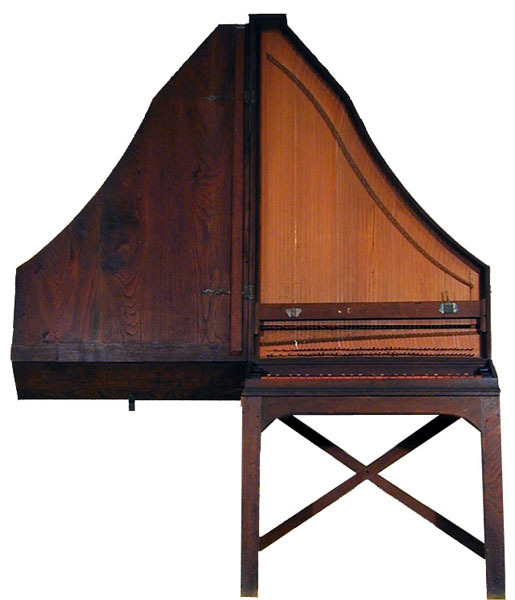
Clavicytherium (Upright Piano)
A rare example of an early piano design, this instrument has few alterations and is in excellent condition. Made of North American hardwoods, ebony, brass, leather. Scholars believe it is one of two surviving instruments made by Johann Gottlob Klemm (1690-1762)(Anglicized as John Clemm), the first professional keyboard instrument maker in British colonial America. According to the wood analysis, this instrument was made in America. It is both one of the earliest forms of piano, and one of the earliest piano-type instruments in America. During a smallpox epidemic in 1746, this instrument was brought to the Whitfield House in Nazareth, Pennsylvania to aid in comforting the patients from the girls' school who were being attended to there. The principal, John Christopher Pyrlaeus, thought that music would raise the spirits of those students affected by the smallpox epidemic. It reportedly has been in the building—now the Moravian Historical Society—since that time. It is not known whether the instrument was made in Germany and brought to America by the Moravians, or whether it was made in the American colonies. Fewer than ten of these instruments can be found today in the United States. Unknown maker and date. From the collection of the Moravian Historical Society, Nazareth, Pennsylvania.
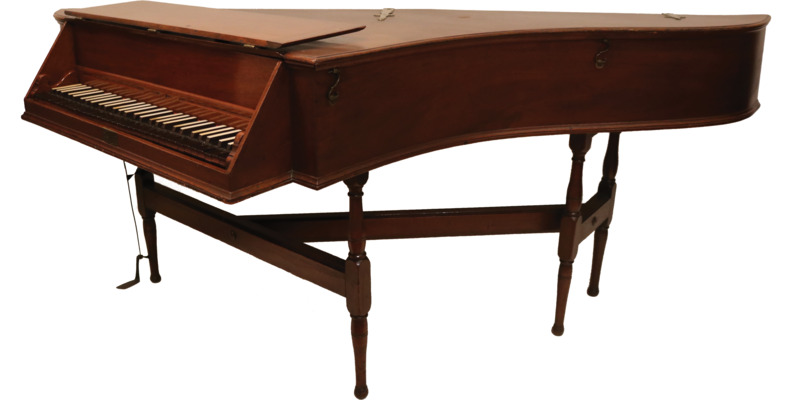
Spinet
The bentside spinet was a favorite domestic keyboard instrument in the 1700s since it takes up less room than the harpsichord, is less complicated to maintain, and produces a powerful tone. David Tannenberg, renowned Moravian organ builder of Lititz, Pennsylvania, established his reputation building clavichords and pipe organs. This instrument shows that he was also capable of producing plucked-string instruments.
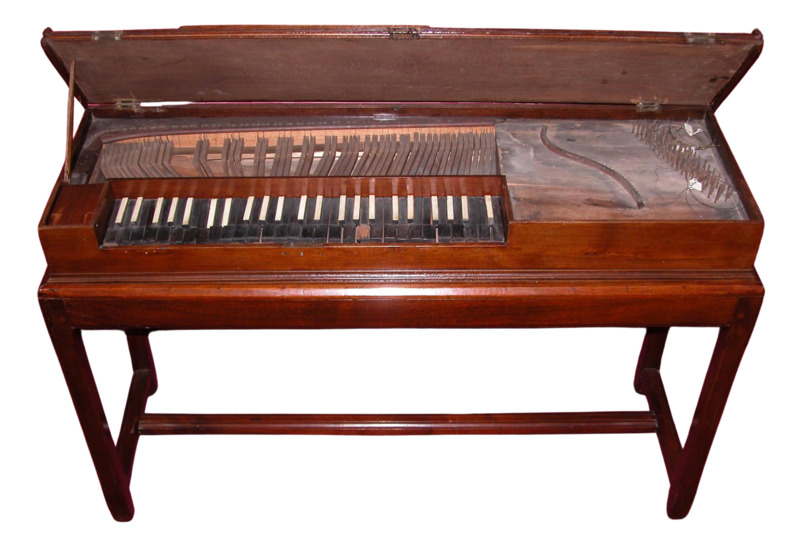
Clavichord
This is the oldest known clavichord made in America, as well as the oldest extant instrument made by David Tannenberg and the only one bearing his signature. Tannenberg built this clavichord while he was apprenticing with John Clemm. Tannenberg would later establish himself as an organ builder however this is a stringed keyboard instrument. A clavichord is a simple box that can sit on a table or rest in a stand with legs, as this one does. The sound is produced by striking the strings with a metal tangent attached directly to one end of the key.