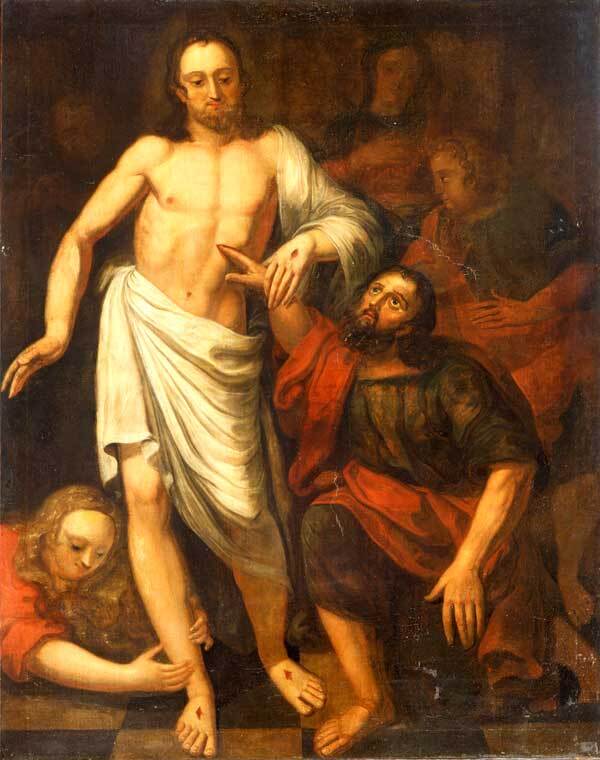
This painting Illustrates the Bible passage, "Then he said to Thomas, ‘Put your finger here and see my hands. Reach out your hand and put it in my side. Do not doubt but believe.’ Thomas answered him, 'My Lord and my God!'" John 20:27-28. The five wounds of the crucifixion are shown on Jesus' body. He stands in a contrapposto position with his eyes gazing downwards and a faint smile on his lips. He guides the hand of Thomas, the apostle who doubted the resurrection, to his pierced side wound. Mary Magdalene cradles Jesus' leg.
This is one of six paintings Haidt made dealing with the death and resurrection of Christ, for the Saal in the Manor House in Nazareth. MHS has all six in the collection, " Christ in Gethsemane", "Christ Scourged", "The Crucifixion", "Lamentation over the Body of Christ", and "Adoration of the Shepards".
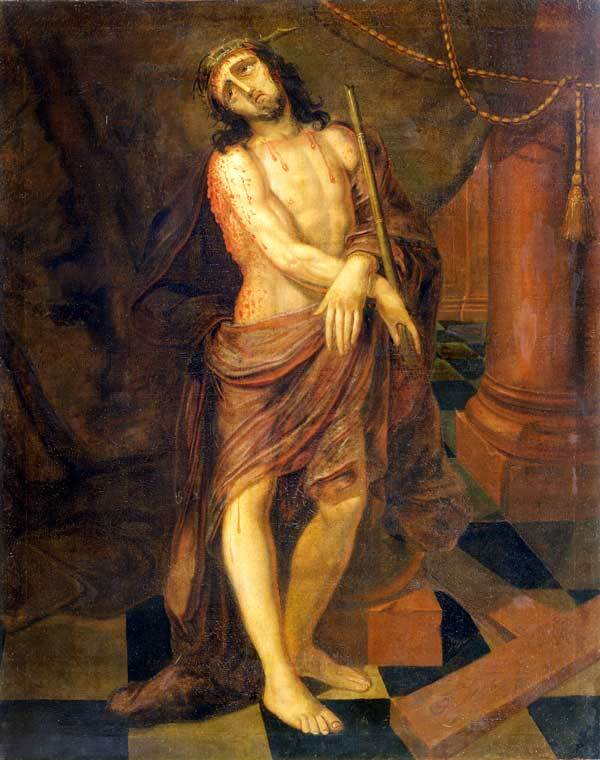
"Christ Scourged", "Jesus Scourged" or "The Mocking of Christ" illustrates the Bible passage, “Then Pilate took Jesus and had him flogged. And the soldiers wove a crown of thorns and put it on his head, and they dressed him in a purple robe. They kept coming up to him, saying, ‘Hail, King of the Jews!’ and striking him on the face.” John 19:1-3
This painting depicts Christ partially draped in a robe with a crown of thorns on head and dripping blood on his shoulder stands with hands crossed and bound, holding a crude scepter. On the floor lays the cross and in the background stands a pillar. Haidt depicts Christ as the "Man of Sorrows" with graphic detailed wounds.
This is one of six paintings Haidt made dealing with the death and resurrection of Christ, for the Saal in the Manor House in Nazareth. MHS has all six in the collection, "Christ in Gethsemane", "Adoration of the Shepherds", "The Crucifixion", "Lamentation over the Body of Christ", and "Thomas Doubting".
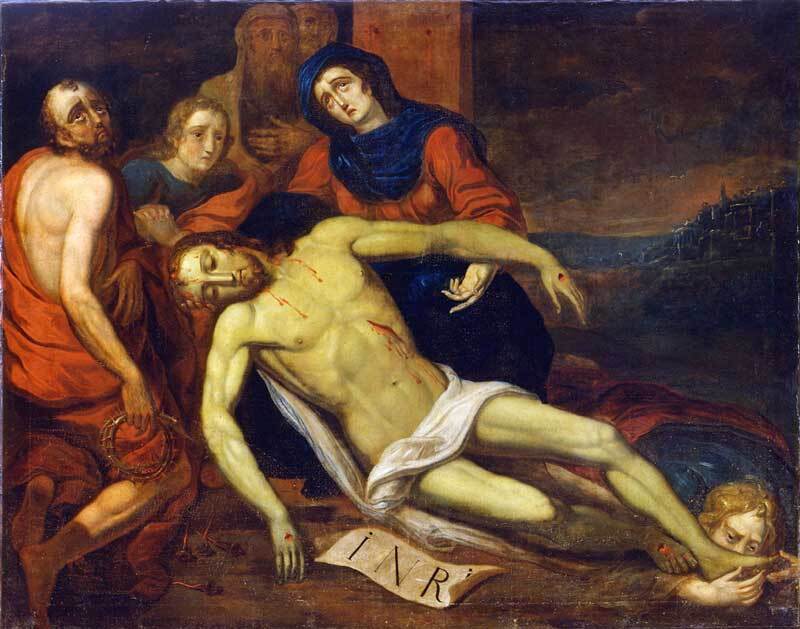
"Lamentation over the Body of Christ" or "At the Foot of the Cross" illustrates the bible passage, ""Joseph of Arimathea, … went boldly to Pilate and asked for the body of Jesus. Then Pilate wondered if he were already dead; and summoning the centurion, he asked him whether he had been dead for some time. When he learned from the centurion that he was dead, he granted the body to Joseph." Mark 15: 43-45.
In the painting, Jesus' body has been removed from the cross. Mary Magdalene kisses his feet. The grieving apostle John and Mary, Jesus' mother, gather near the body, supporting the head and holding the removed crown of thorns. The removed nails lay on the earth in the foreground. Blood issues from the five wounds of the crucifixion and from the cuts on his head made by the crown of thorns.
This is one of six paintings Haidt made dealing with the death and resurrection of Christ, for the Saal in the Manor House in Nazareth. MHS has all six in the collection, " Christ in Gethsemane", "Christ Scourged", "The Crucifixion", "Adoration of the Shepherds", and "Thomas Doubting".
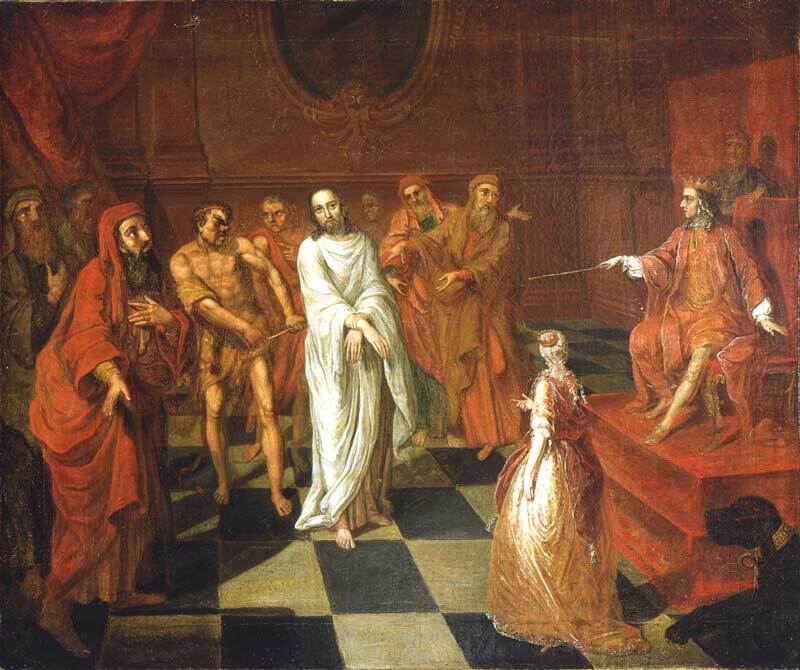
Colored oil on canvas painting of "Christ Before Herod" or "Jesus before Herod" (also sometimes called "Christ before Pilate"). Illustrates the Bible passage, Luke 23:8-10.
Jesus is brought before King Herod, who questions him. Queen Herodias, dressed in fine clothing, looks on from the foot the throne.
This is one of four paintings Haidt made showing the events of Passion Week for the Saal of the single sisters' house in of Nazareth. MHS has two others from the set "The Betrayal of Christ" and "Christ before the Mob".
Excerpt from 1972 Berkeley University Art Museum catalog entry by Jane Dillenberger:
"Despite the richness of detail, the figure of Christ explicitly dominates the scene, an effect Haidt achieved by central placement, the white garments, and the quietude of Christ's mien and posture contrasted with the gesticulating crowd. This painting, dating from about 1765, originally belonged to the Moravian Settlement in Hope, New Jersey. Contemporary diaries reveal that the emphasis on Christ's blood and wounds was not so intense as formerly."
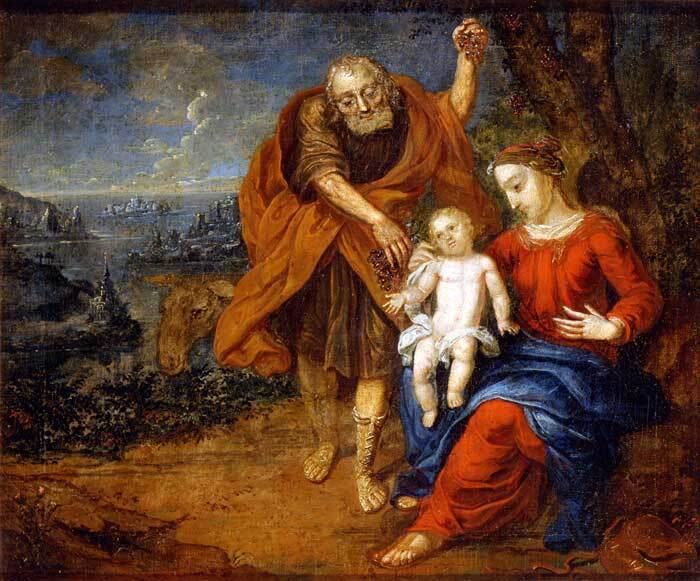
Colored oil painting on canvas of Jesus, Mary, and Joseph seated by the roadside, eating grapes that Joseph has just pulled from a vine hanging overhead.
Description from 1982 exhibition by Charlene Engel:
"In this delightful, small painting the blue glazing, the watery landscape and the cloud-filled sky are reminiscent of the work of such landscapists as Joachim Patinir (c. 1475-1524). An elderly Joseph offers grapes, symbolic of Christ's sacrificial blood, to the child on his mother's knee. The head of Mary's donkey peers out from behind Joseph in the middle ground of the painting."