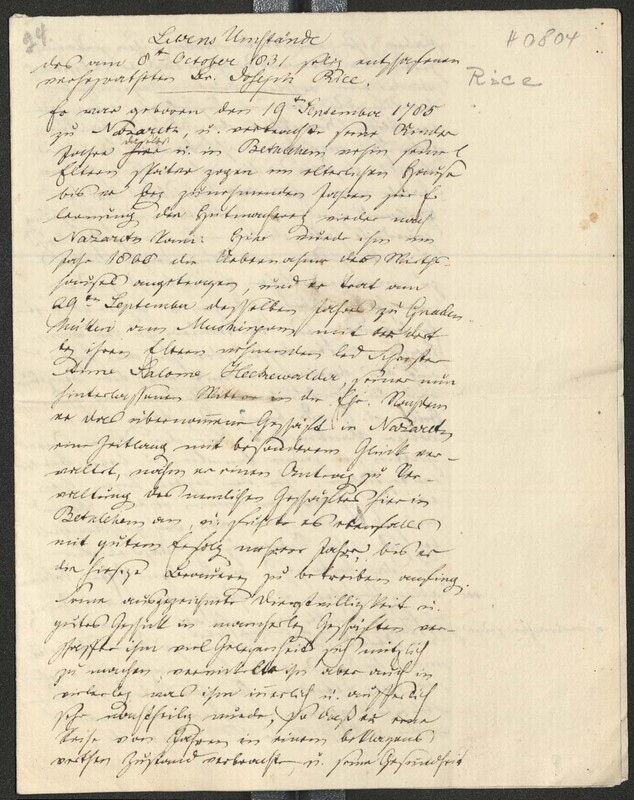
This Moravian memoir recounts the life of Joseph Rice, born in Nazareth in 1785, who spent his life working in Moravian communities as a hat maker, tavern keeper, and brewer. Married in 1808 to Anne Salome Heckewelder in Gnadenhütten, he became known for his willingness to serve and skill in business, though the memoir also reflects on personal struggles that affected his health and spiritual life. During his final illness in 1831, he underwent a period of deep self-examination, renewed trust in Christ’s mercy, and constant prayer before dying peacefully at age 46 surrounded by his family in Bethlehem.
In his memoir, Johann Friedrich Peter describes his childhood in Holland and in Niesky. He attended the seminary in Barby and joined the Single Brothers' Choir in 1770. In 1779, he was called to Salem, North Carolina. He then served in several congregations like Graceham, Maryland, and Hope, New Jersey. Peter's memoir ends in 1792. Another brother or sister finished it by recounting his last years in Bethlehem where he served with "exemplary faithfulness".
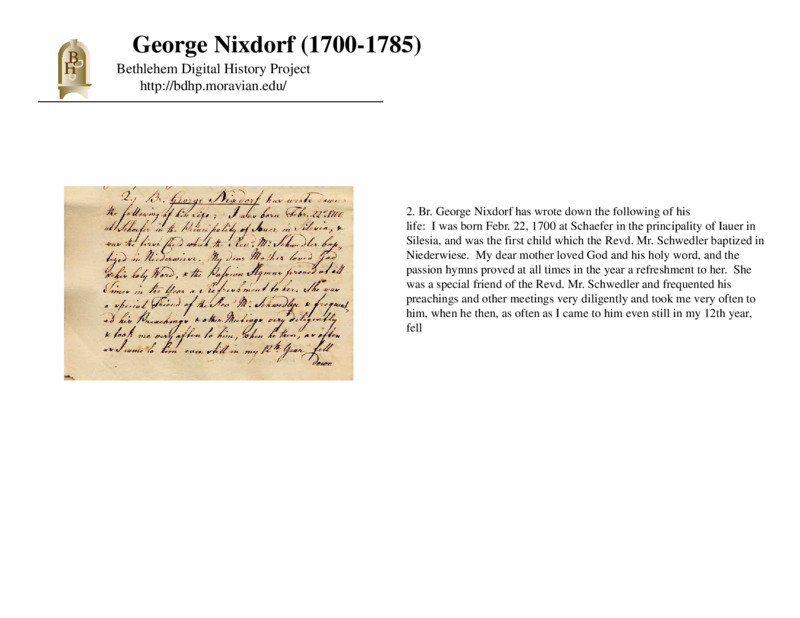
In this memoir, George Nixdorf describes his birth and childhood in Silesia. He was raised by a very pious mother and he remembers the awakening of the children of Silesia in 1708. Later in his life, he met Moravians (including Christian David) in a tavern where he was working. After a much troubled life, he arrived in Herrnhut in 1742. The following year, he and his wife traveled to Pennsylvania serving multiple congregations including Lancaster. The memoir was finished by another brother or sister who describes Nixdorf's unwavering faith and recounts his last years.
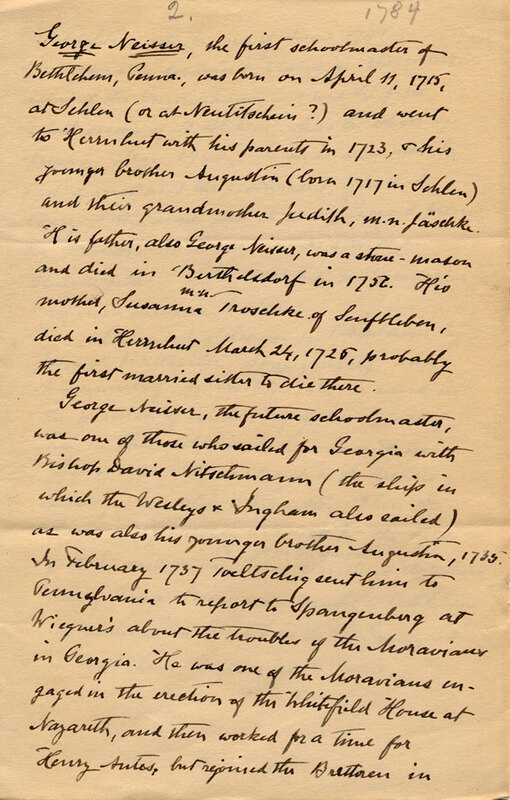
The author of this short biography wrote this account of George Niesser's life towards the end of the 19th century. He recounts his birth in Germany then his journeys to first Georgia and then Pennsylvania. He was the pastor of various congregations including Philadelphia where he died in 1784.
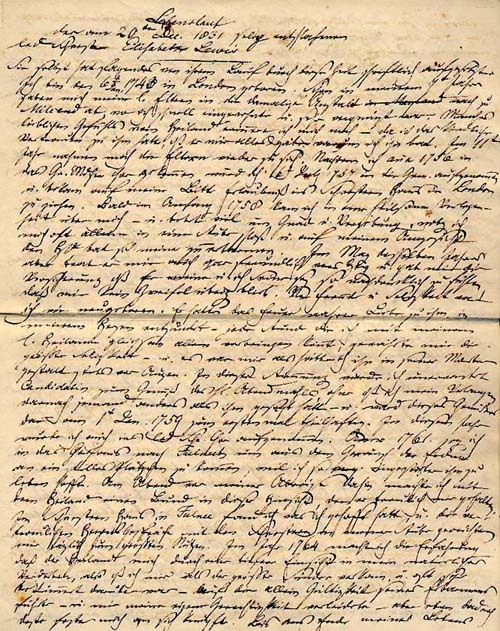
In this memoir, Elizabeth Lewis recounts her childhood in England and her awakening when she entered the Sisters' House. She ardently describes her deep faith and the comfort that she finds in her Savior. In 1767, she moved to Herrnhut where she learned German. In 1783, she answered a call to join the Sisters' Choir in Bethlehem, Pennsylvania. The memoir was finished by another brother of sister who describes her health issues and her last years in Bethlehem.
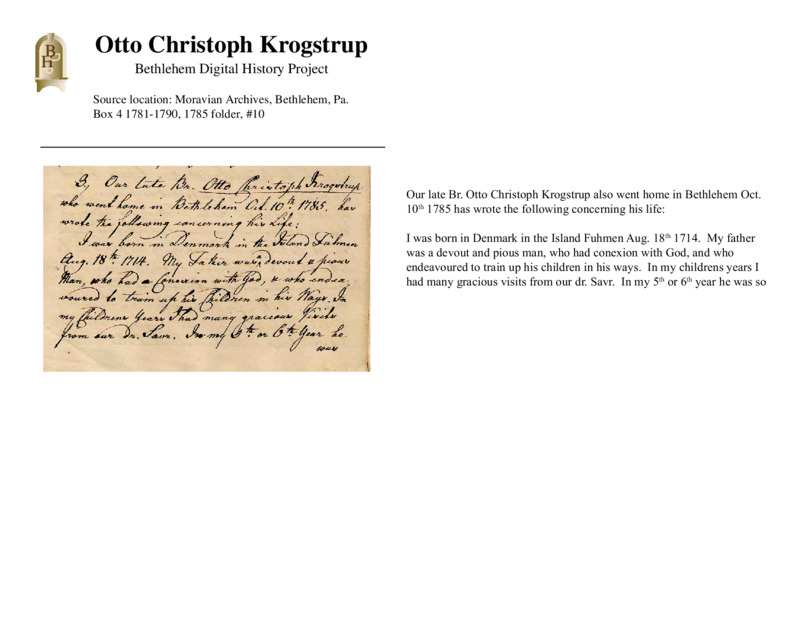
In this memoir, Otto Christoph (Christian) Krogstrup recounts his birth and pious childhood in Denmark as well as his awakening during his higher education. He also describes his "spiritual birth" as an adult. He was ordained and served congregations in Denmark. But he was dismissed because he wouldn't grant absolution to people who came to him for confession. After 1748, he traveled through Herrnhut, Marienborn, Herrnhag, and Barby. He left in 1753 for America where he served several Moravian congregations. Another brother or sister finishes the memoir recounting his faithful heart and the last years of his ministry and the state of his declining health. Written in calligraphy.
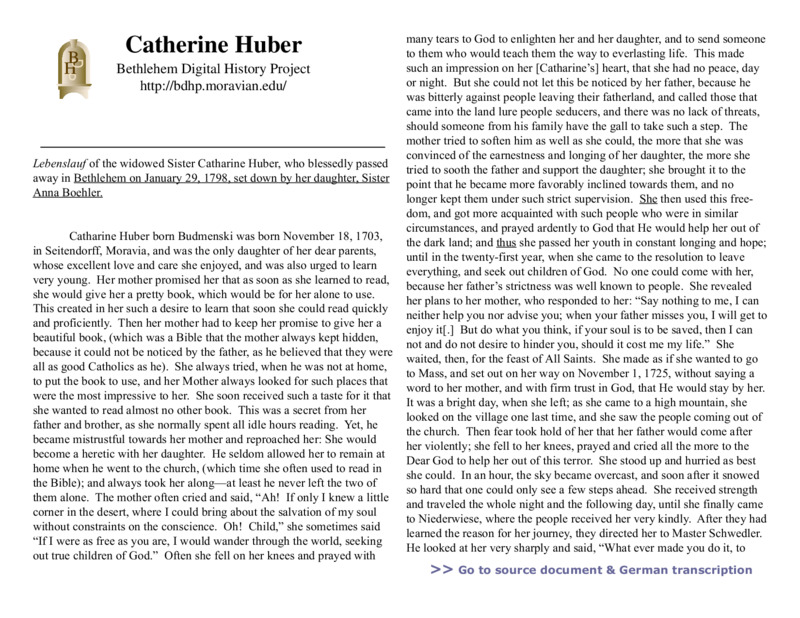
This memoir written by Catherine's daughter recounts Catherine's difficult childhood as she was raised by a conservative Catholic father and a pious (Protestant) mother. Both had to hide their faith and their spiritual longings. Catherine ran away from home in 1725 and moved to Herrnhut where her mother eventually joined her. She and her first husband were called to Georgia where she played an active role in the mission to the Indians. After meeting with Count Zinzendorf, she moved to Bethlehem, Pennsylvania, where she married for a third time. She became a widow again and spent the rest of her life between Nazareth and Bethlehem, faithfully answering the communities' calls. Written in German calligraphy.
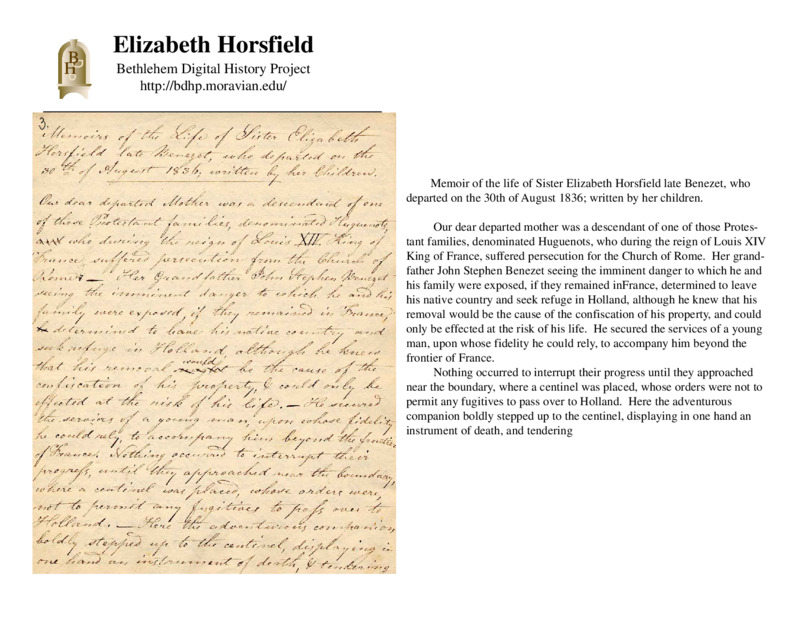
Elizabeth's children describe her Huguenot family ancestry and how they escaped France to finally arrive in Philadelphia, Pennsylvania. Her family was acquainted with Brother Spangenberg and Count Zinzendorf. Elizabeth received a liberal education in Philadelphia and moved to Bethlehem, Pennsylvania when she was 21, a Moravian community in which she spent the rest of her life. Her children mentioned that she suffered from "nervous affections" and forgetfulness but she never lost her love for her Savior.
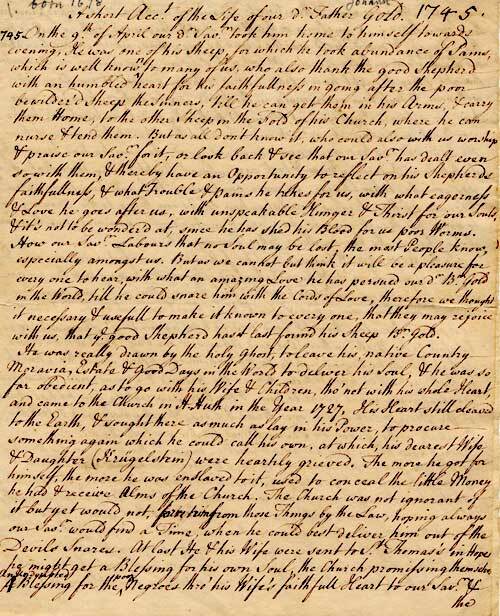
This memoir is written in calligraphy by another brother or sister upon Johann Gold's death. It recounts his childhood in Moravia and then Herrnhut as well as his call by the Moravian Church to St. Thomas. The narrator recounts that, for a very long time, Gold was a "bitter enemy" of the Moravian Church. Eventually, the love of the Lord overwhelmed Gold and it took over his life as a missionary.
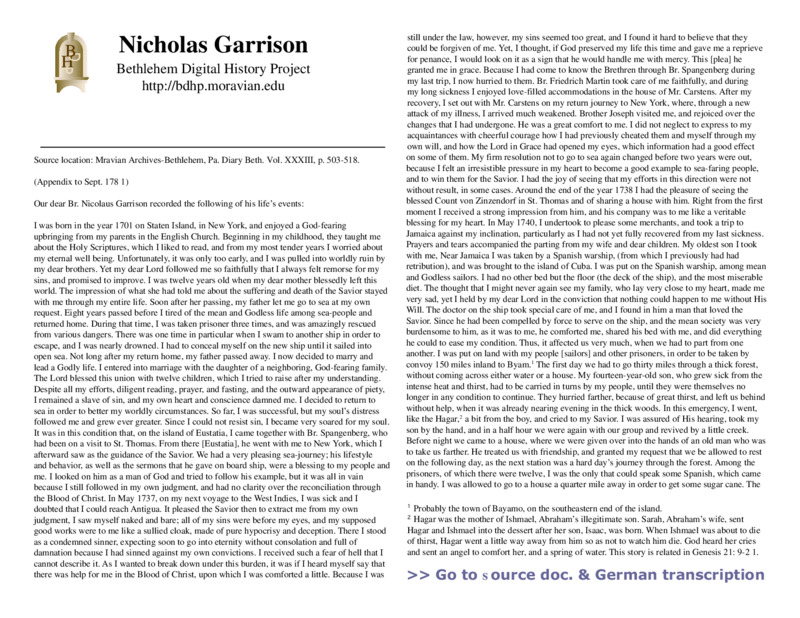
In his memoir, Nicholas Garrison describes his early years as well as his early experience as a sailor when he was overtaken by sin and lived only an "outward appearance of piety." In his life, he met with prominent Moravians like Brothers Spangenberg and Count Zinzendorf. He recounts his conversion experience as he got close to the Brethren. He also narrates his experience as a prisoner and how he enjoyed the Lord's protection amid the difficult experiences. Garrison was the captain of the Irene that transported Moravian missionaries to and from Europe to America and the Eastern West Indies. He ended his life in Bethlehem, Pennsylvania. Another brother or sister finished his memoir recounting his last days and remembering his service to the Lord.
John Ettwein's memoir in which he recounts his ancestry, his religious education, his pious childhood, and his conversion experience as a teenager. He talks about his experience in Hernnhut during the Sifting Time. He recounts his travels throughout Germany and England and his call to America in 1754. He talks about his "pilgrimage" throughout his missionary work in 12 states. He highlights his pious devotion and the Lord's protection throughout his life. The memoir is completed by another brother or sister who recounts the last years of his life. Written in German calligraphy.
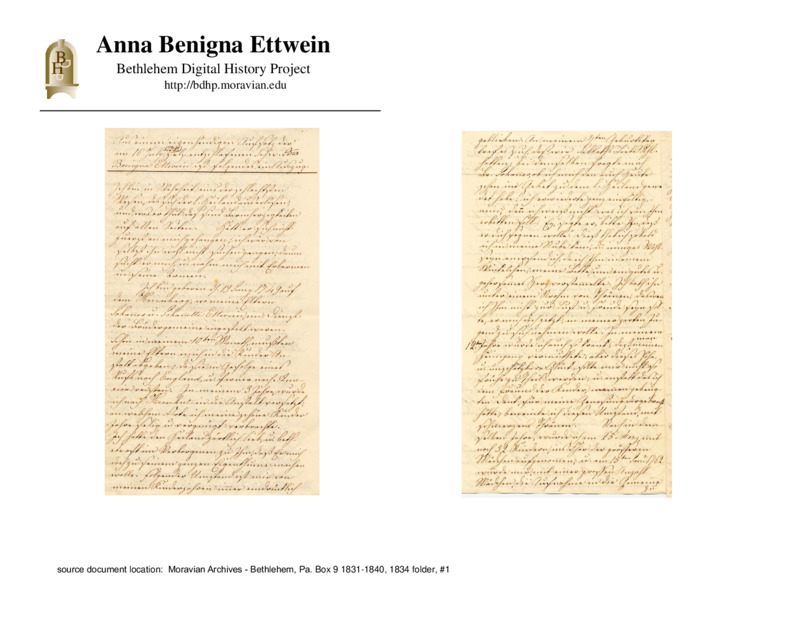
Memoirs of Anna Banigna Ettwein (1749-1834) describing her childhood in Germany, her conversion experience as a child, her faith as it was tested by hardships, and her relocation to Bethlehem, PA. The last part of the memoir was added by another contributor describing her illness and her faith in times of struggle.
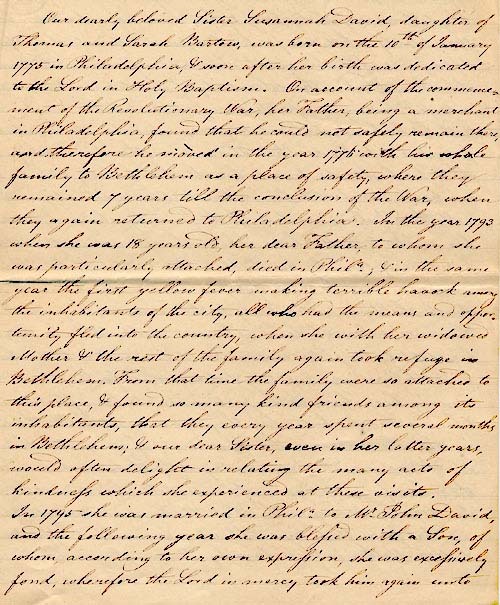
This memoir recounts the life of Susannah David, born in Philadelphia in 1778 during the Revolutionary War, whose family repeatedly sought refuge in Bethlehem during times of hardship and loss. Widowed after the death of her husband in Ohio, she later returned to Bethlehem, where her connection to the Moravian community deepened and became a source of spiritual comfort. Remembered for her patience, deep religious faith, and trust in the Savior through years of suffering and illness, she faced death peacefully in 1844 while expressing gratitude for God’s mercy and longing to be with Christ. Written in calligraphy.
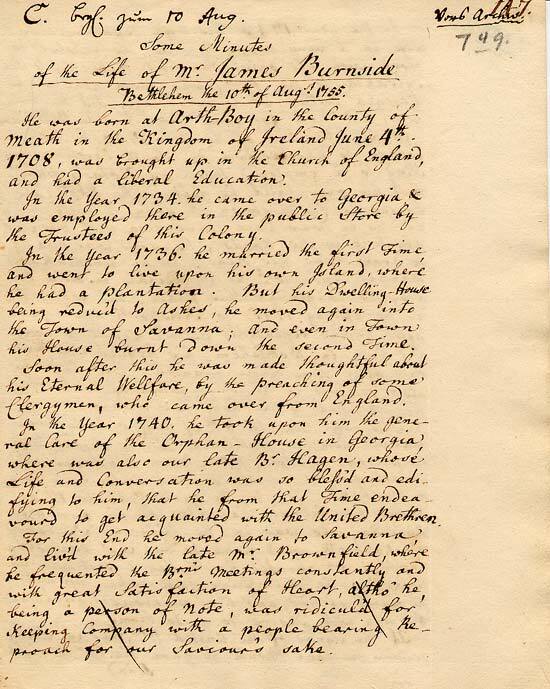
A four page account of James Burnside's life detailing his early life, immigration to America, personal hardships, and increasing devotion to faith, particularly his eventual commitment to the Moravian Brethren. The narrative highlights his religious awakening, missionary work, and final moments, emphasizing his struggle with faith and ultimate peace in his belief in Christ. Written in calligraphy.
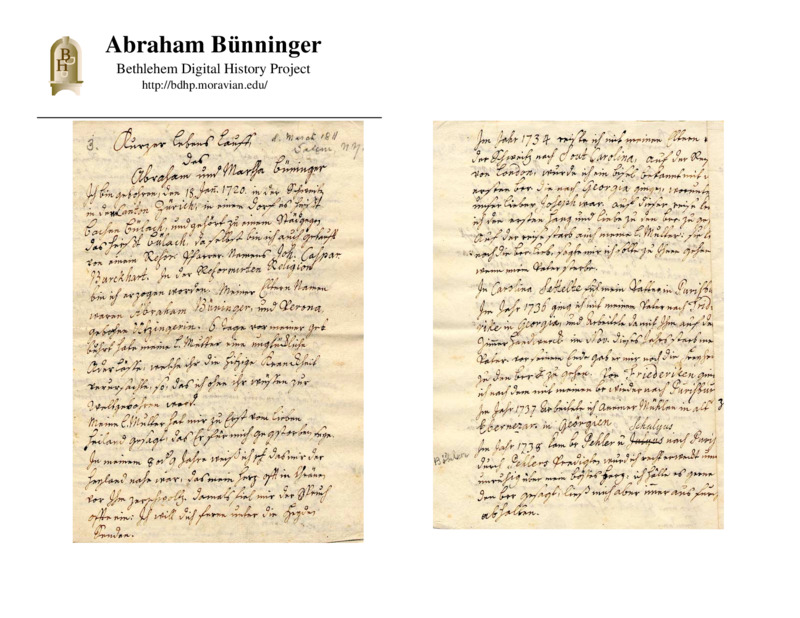
A translated 8 page account of Abraham Bünninger's life highlighting his deep faith, struggles with spiritual doubts, and dedication to religious work, teaching, and spreading Christianity. Written in calligraphy.
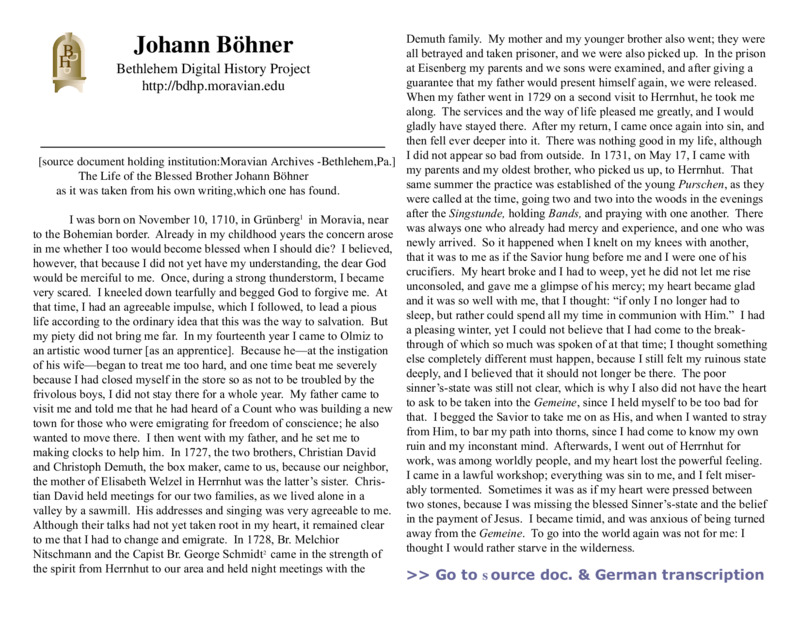
This document is a translated excerpt from "The Life of the Blessed Brother Johann Böhner," based on his own writings. It details his concern about salvation from a young age and his struggles with his feelings of unworthiness. Over time, through prayer and reflection, he found peace and a stronger connection to his faith.
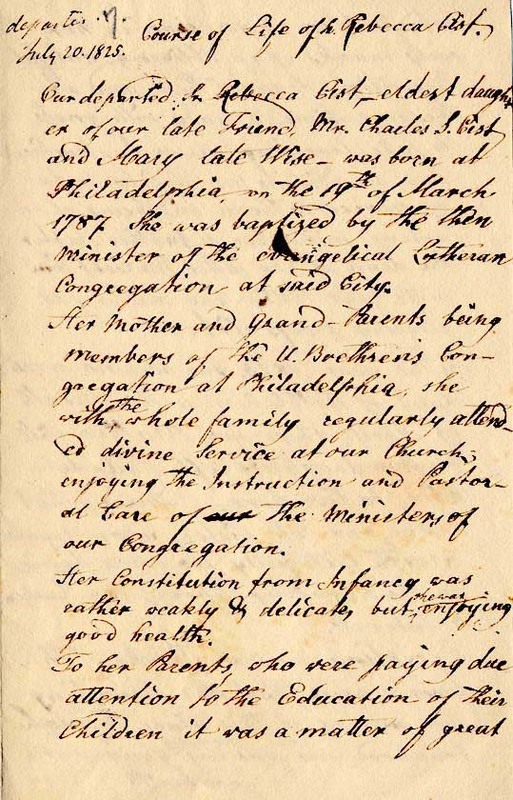
Lebenslauf of Rebecca Cist (1787-1825) . A four page account of Rebecca Cist's life written in English and in calligraphy. This memoir recounts the life of Rebecca Cist, born in Philadelphia in 1787, who was raised in a family closely connected to the Moravian Church and later moved to Bethlehem with her mother and sisters. Known for her dutiful nature, love of learning, and willingness to serve others, she worked for a time as a teacher in the Boarding School at Bethlehem. After a sudden illness in 1825, she faced death with quiet spiritual reflection and trust in the Savior, passing peacefully at the age of 39.
Wool cross-stitch on linen created by Caroline Louisa Kummer, 1828.
Samplers allowed girls to learn practical stitchery, as proper housekeeping required that all clothing and household linens be marked with the initials of the owner. Beginning in the 17th century samplers included alphabets, signatures, dates and verse. Girls of all classes, ages 5 to 9, would work samplers under the supervision of either a mother, grandmother or teacher. Girls who went to school continued with fancy embroidery if the family could afford it. For the alphabet samplers, depending on the year created, the letter "J" is absent. The German language, commonly used in Moravian schools through the early 19th century, did not have an equivalent sound to the letter "J", and so the letter was not considered a proper letter. The stitcher sometimes added inventive design motifs such as family possessions, pets, birds, houses, or trees. This sampler contains two alphabets -- one with a "J" and the other without.
Needlework piece made by Diademia Austin Haines while she was a student at Moravian Seminary in 1817. The piece is a large rectangular mourning piece on silk in frame. A woman in brown dress leaning with her head bowed against neutral color urn. The woman is standing in pond surrounded by black border embellished with a repeating pattern of spangles. A weeping willow tree in gold and green is in the background.
In the early 1800s, mourning embroidery became popular across the nation, as an expression of overwhelming grief following the death of George Washington. The mourning piece later transcended its original purpose and became a fashionable needlework motif exemplifying refinement and culture. Mourning pieces included the use of India ink, paint or pencil to draw facial features and hands. A professional artist or teacher would be commissioned for the drawing. The black chain stitched border with fancy spangles was popular on mourning pieces made at the Moravian Seminary for Young Ladies in Bethlehem.
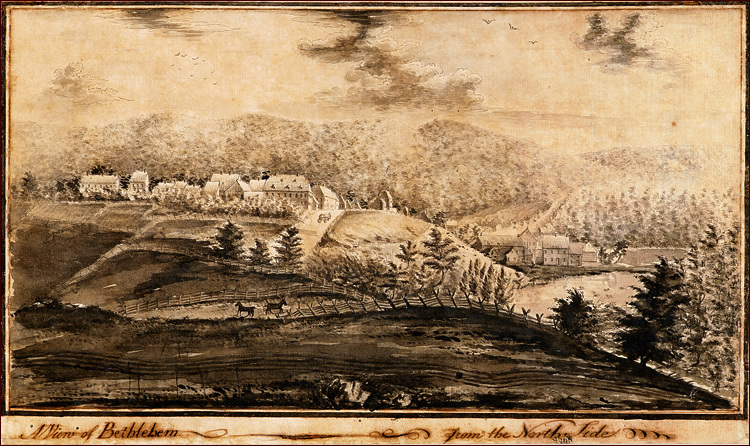
Landscape painting of Bethlehem from the north, looking south from the perspective of modern-day Comenius Hall towards the city, where a horse-drawn wagon enters. Visible buildings at left include the Sun Inn, the Horsfield House and Stranger's Store. The Colonial Industrial Quarter is visible at right. Horses and wooden fences are visible in the foreground, and South Mountain is visible in the distance. Several ducks (or other waterfowl) are visible in the Monocacy Creek at right.
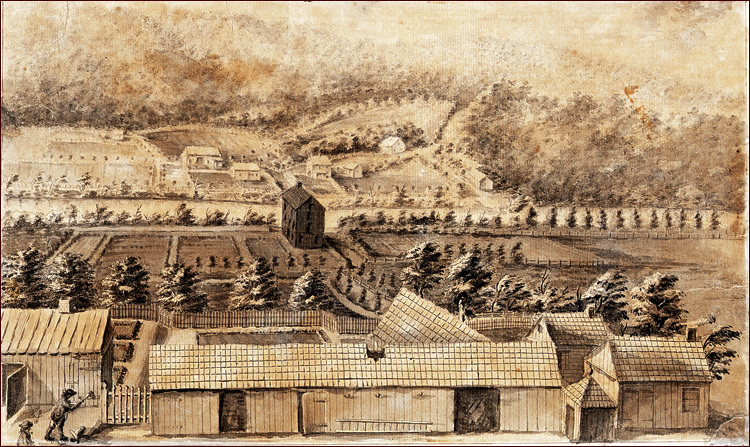
Landscape painting of Bethlehem from the north, looking south from the perspective of Single Brother's House towards the Crown Inn and other structures on the south side of the Lehigh River. Visible in the foreground are various outbuildings and gardens used by the choir houses. South Mountain is visible in the background.
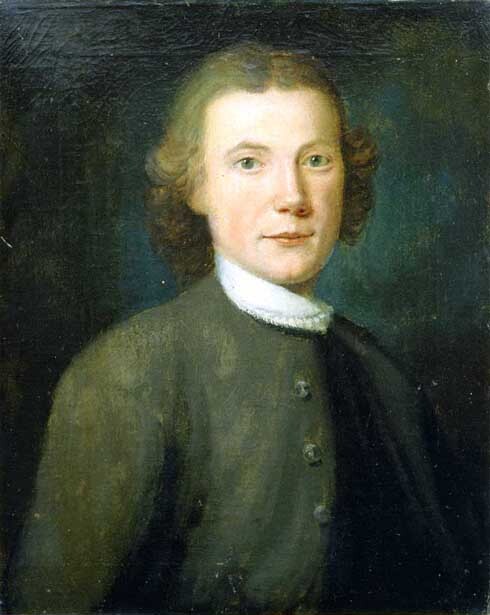
This is a colored portrait of John Ettwein (1721-1802). Ettwein and his wife, Johannetta Maria Ettwein came to America in 1754. Their portraits were painted by a fellow traveler, John Valentine Haidt, supposedly during the voyages.
During the Revolutionary War, Ettwein was the chief spokesman to the Continental Congress and other officials on behalf of the Moravians in Pennsylvania. He was consecrated a Bishop in 1784, and became head of the governing board of the Moravian Church in America.
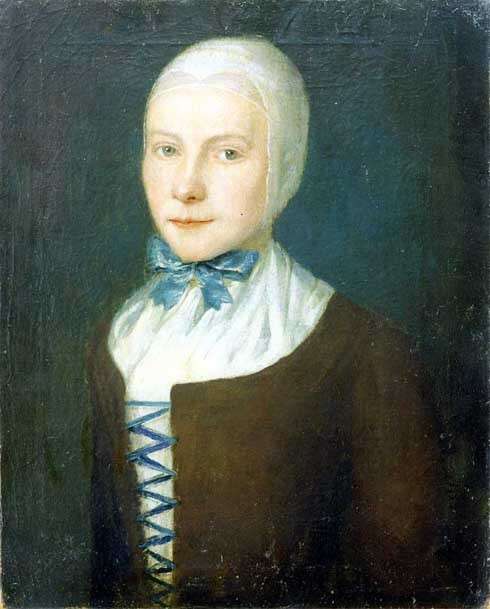
In this colored portrait of Johannetta Maria Kymbel Ettwein (1725-1789), she wears clothing typical of a Moravian woman during the General Economy, including a Schneppelhaube, or head covering, and blue ribbons that identify her as a Married Sister. Johannetta joined the Moravians in Germany in 1741 and married John Ettwein in 1746.
She came with her husband to Bethlehem in 1754, where she lived the rest of her life.
This colored piece was painted by an unknown artist of an unidentified Moravian Single Sister. The pink bow denotes that she was single. Married Sisters are pictured with blue bows.