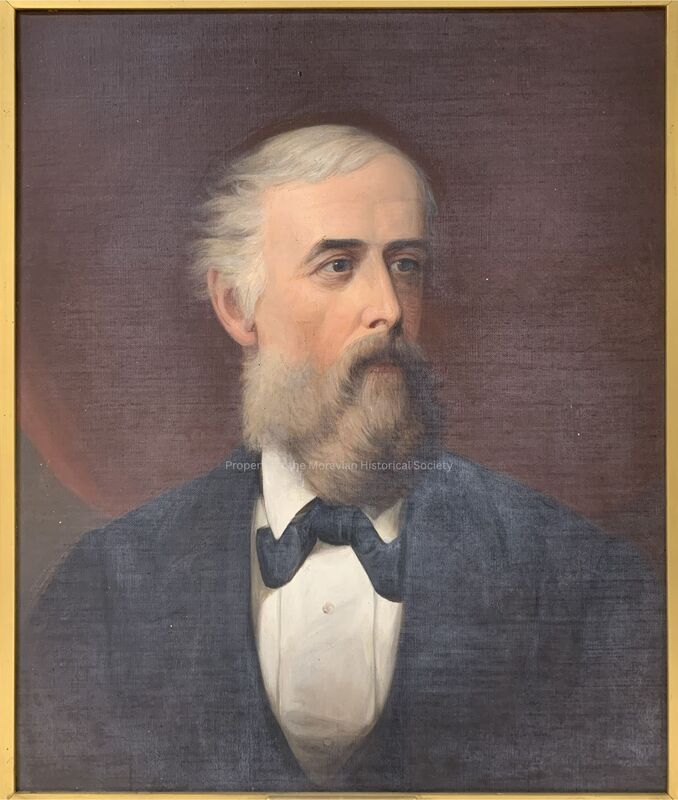
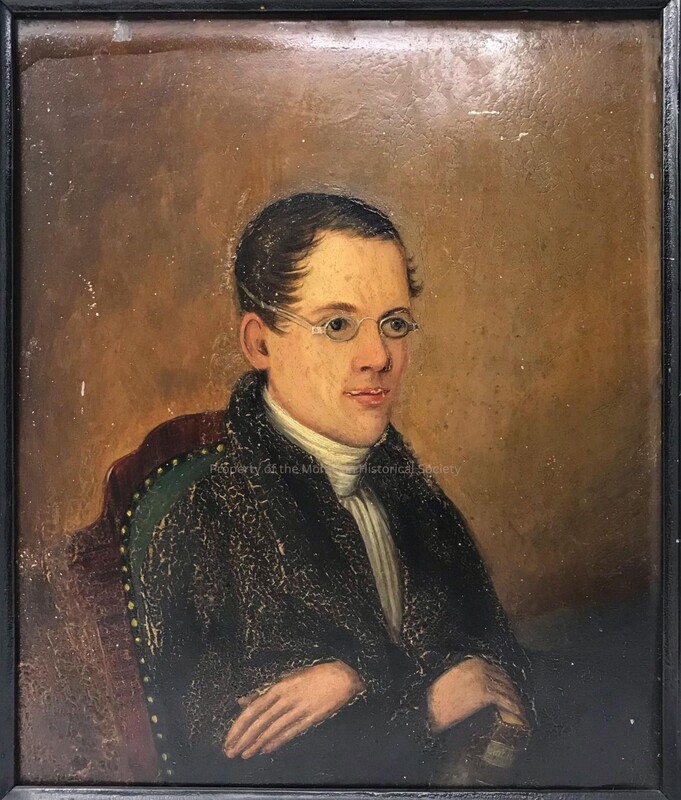
Reinke, Samuel (1818)
Portrait of a young man from the side, black jacket, white scarve, in oval
Samuel Reinke (1791‐1875), born in Lititz, Brüderpfleger and ‐Vorsteher in Lititz (1816‐1819), married with Susanna Theodora Eyerle (1819), ordained a deacon (1819) and served in Lancaster, Philadelphia, Newport, Lititz. In 1826 Susanna Re‐inke died in Lititz and Samuel remarried with Charlotte Sophia Hüffel (1827). They served in Graceham, Lancaster, Nazareth, Bethlehem, New York, and in Lititz. He was a member of the PHC (1839‐1847) and was ordained a bishop (1858). Samuel Reinke suffered from a weak health. He died in Bethlehem.
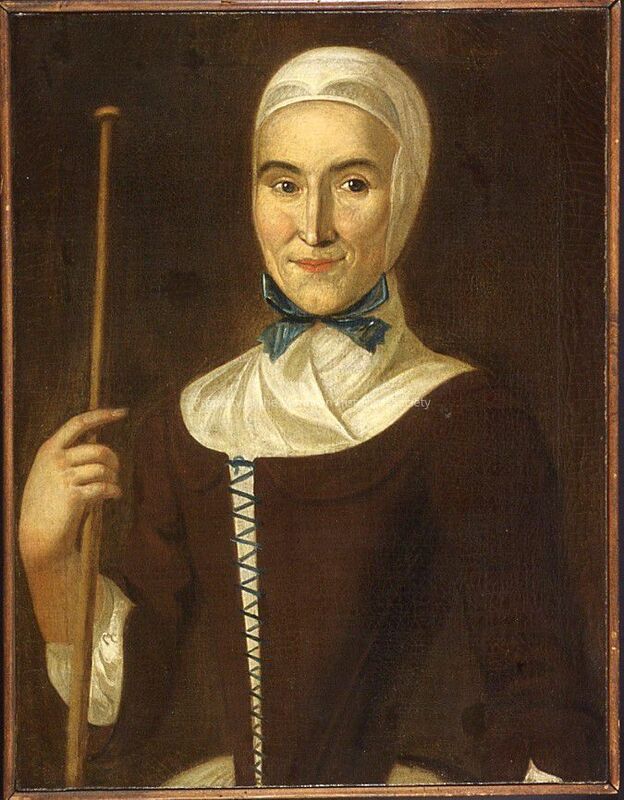
Portrait of Johanna Ingerheidt Schmick (1721-1795)
Schmick was a missionary to the Delaware and Mahican Indians first in Gnadenhütten, Pennsylvania in 1751 and later in Gnadenhütten, Ohio in 1773. Gnadenhütten translates to "village of grace." In 1782, U.S. militiamen from Pennsylvania attacked the Ohio settlement and massacred 96 men, women, and children who were pacifist Moravian Indians (primarily Lenape and Mohican).
Born Johanna Ingerheidt in Larvik, Norway, she arrived in Pennsylvania in 1752 on
the Moravian transport the Irene. She married John Jacob Schmick in 1752 in Bethlehem.
Restoration funded by Mr. and Mrs. Walter L. Peters
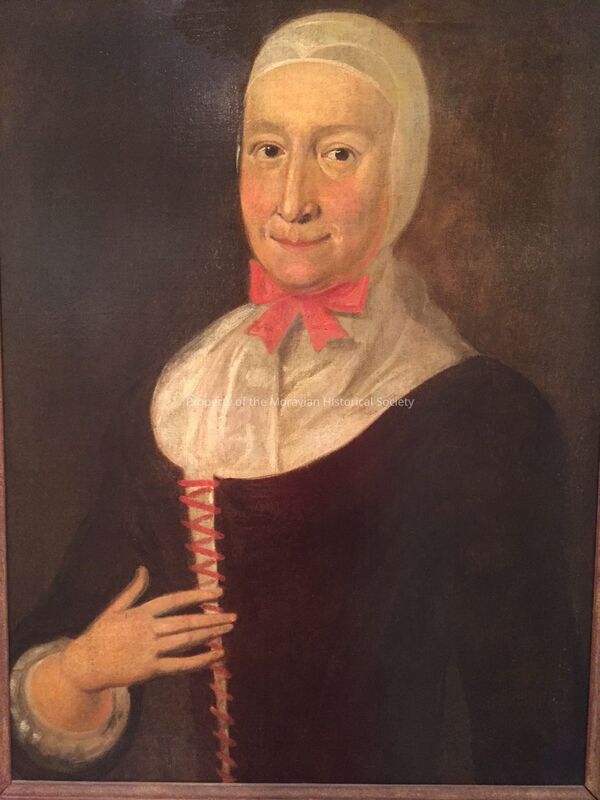
Portrait of Catherine Huber (1703-1798)
Huber moved to Nazareth during the General Economy period. She cared for the community’s sick and oversaw the nursery, which was located in this building. Children between the ages of 18 months and four years lived together in the nursery under the care of a few Single Sisters. The nursery allowed parents to contribute to the General Economy without the interruption of child rearing. Children in the nursery learned hymns by heart and practiced remaining attentive throughout religious services. At bedtime, the children sang an evening hymn.
Wool cross-stitch on linen created by Caroline Louisa Kummer, 1828.
Samplers allowed girls to learn practical stitchery, as proper housekeeping required that all clothing and household linens be marked with the initials of the owner. Beginning in the 17th century samplers included alphabets, signatures, dates and verse. Girls of all classes, ages 5 to 9, would work samplers under the supervision of either a mother, grandmother or teacher. Girls who went to school continued with fancy embroidery if the family could afford it. For the alphabet samplers, depending on the year created, the letter "J" is absent. The German language, commonly used in Moravian schools through the early 19th century, did not have an equivalent sound to the letter "J", and so the letter was not considered a proper letter. The stitcher sometimes added inventive design motifs such as family possessions, pets, birds, houses, or trees. This sampler contains two alphabets -- one with a "J" and the other without.
Needlework piece made by Diademia Austin Haines while she was a student at Moravian Seminary in 1817. The piece is a large rectangular mourning piece on silk in frame. A woman in brown dress leaning with her head bowed against neutral color urn. The woman is standing in pond surrounded by black border embellished with a repeating pattern of spangles. A weeping willow tree in gold and green is in the background.
In the early 1800s, mourning embroidery became popular across the nation, as an expression of overwhelming grief following the death of George Washington. The mourning piece later transcended its original purpose and became a fashionable needlework motif exemplifying refinement and culture. Mourning pieces included the use of India ink, paint or pencil to draw facial features and hands. A professional artist or teacher would be commissioned for the drawing. The black chain stitched border with fancy spangles was popular on mourning pieces made at the Moravian Seminary for Young Ladies in Bethlehem.
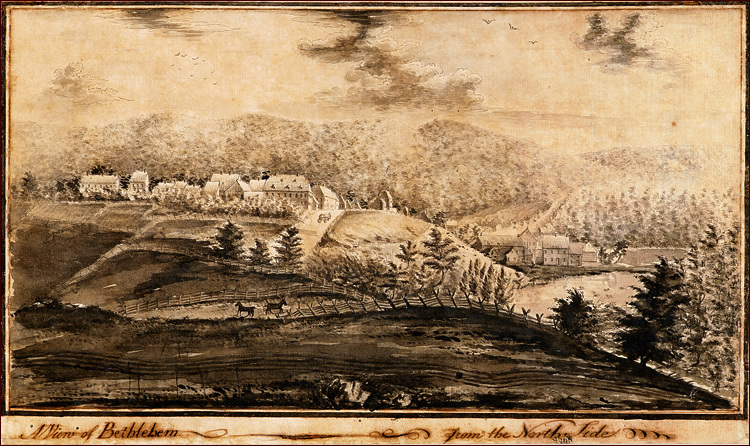
Landscape painting of Bethlehem from the north, looking south from the perspective of modern-day Comenius Hall towards the city, where a horse-drawn wagon enters. Visible buildings at left include the Sun Inn, the Horsfield House and Stranger's Store. The Colonial Industrial Quarter is visible at right. Horses and wooden fences are visible in the foreground, and South Mountain is visible in the distance. Several ducks (or other waterfowl) are visible in the Monocacy Creek at right.
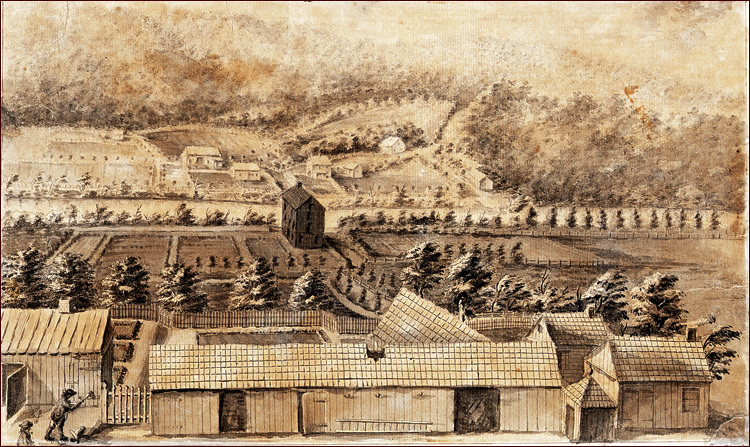
Landscape painting of Bethlehem from the north, looking south from the perspective of Single Brother's House towards the Crown Inn and other structures on the south side of the Lehigh River. Visible in the foreground are various outbuildings and gardens used by the choir houses. South Mountain is visible in the background.
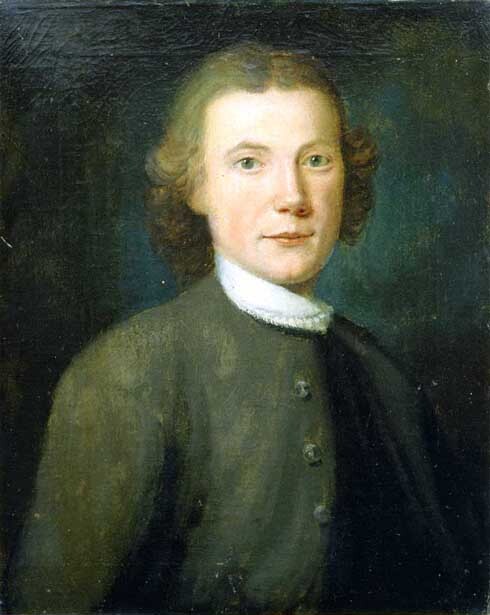
This is a colored portrait of John Ettwein (1721-1802). Ettwein and his wife, Johannetta Maria Ettwein came to America in 1754. Their portraits were painted by a fellow traveler, John Valentine Haidt, supposedly during the voyages.
During the Revolutionary War, Ettwein was the chief spokesman to the Continental Congress and other officials on behalf of the Moravians in Pennsylvania. He was consecrated a Bishop in 1784, and became head of the governing board of the Moravian Church in America.
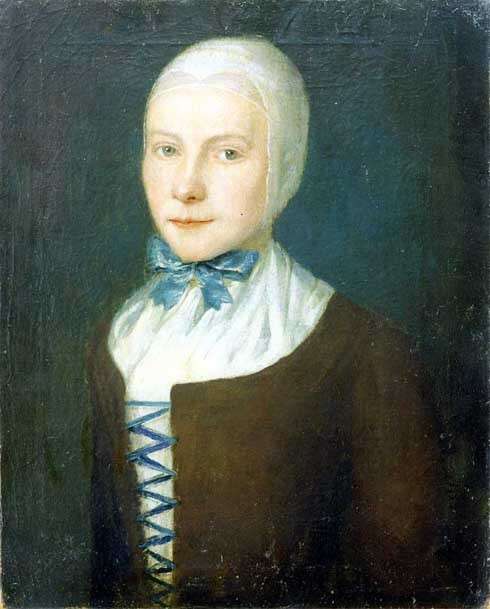
In this colored portrait of Johannetta Maria Kymbel Ettwein (1725-1789), she wears clothing typical of a Moravian woman during the General Economy, including a Schneppelhaube, or head covering, and blue ribbons that identify her as a Married Sister. Johannetta joined the Moravians in Germany in 1741 and married John Ettwein in 1746.
She came with her husband to Bethlehem in 1754, where she lived the rest of her life.
This colored piece was painted by an unknown artist of an unidentified Moravian Single Sister. The pink bow denotes that she was single. Married Sisters are pictured with blue bows.
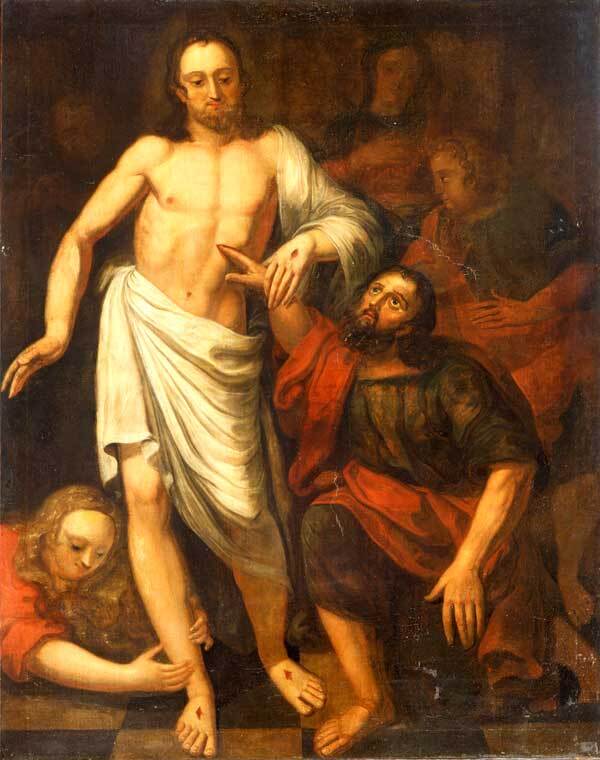
This painting Illustrates the Bible passage, "Then he said to Thomas, ‘Put your finger here and see my hands. Reach out your hand and put it in my side. Do not doubt but believe.’ Thomas answered him, 'My Lord and my God!'" John 20:27-28. The five wounds of the crucifixion are shown on Jesus' body. He stands in a contrapposto position with his eyes gazing downwards and a faint smile on his lips. He guides the hand of Thomas, the apostle who doubted the resurrection, to his pierced side wound. Mary Magdalene cradles Jesus' leg.
This is one of six paintings Haidt made dealing with the death and resurrection of Christ, for the Saal in the Manor House in Nazareth. MHS has all six in the collection, " Christ in Gethsemane", "Christ Scourged", "The Crucifixion", "Lamentation over the Body of Christ", and "Adoration of the Shepards".
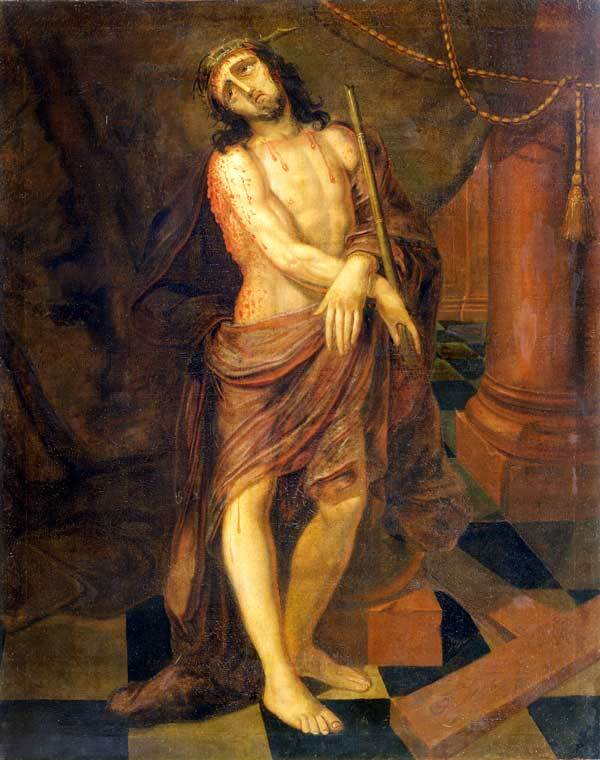
"Christ Scourged", "Jesus Scourged" or "The Mocking of Christ" illustrates the Bible passage, “Then Pilate took Jesus and had him flogged. And the soldiers wove a crown of thorns and put it on his head, and they dressed him in a purple robe. They kept coming up to him, saying, ‘Hail, King of the Jews!’ and striking him on the face.” John 19:1-3
This painting depicts Christ partially draped in a robe with a crown of thorns on head and dripping blood on his shoulder stands with hands crossed and bound, holding a crude scepter. On the floor lays the cross and in the background stands a pillar. Haidt depicts Christ as the "Man of Sorrows" with graphic detailed wounds.
This is one of six paintings Haidt made dealing with the death and resurrection of Christ, for the Saal in the Manor House in Nazareth. MHS has all six in the collection, "Christ in Gethsemane", "Adoration of the Shepherds", "The Crucifixion", "Lamentation over the Body of Christ", and "Thomas Doubting".
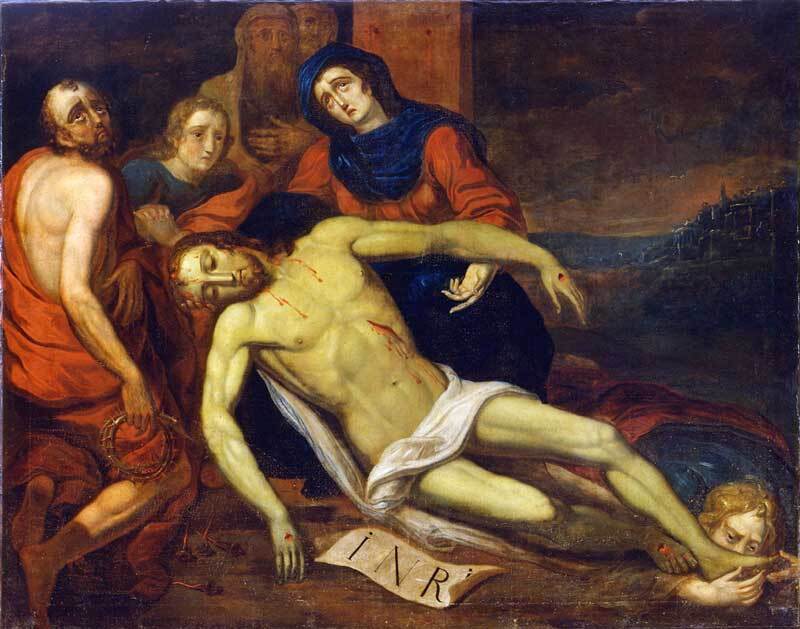
"Lamentation over the Body of Christ" or "At the Foot of the Cross" illustrates the bible passage, ""Joseph of Arimathea, … went boldly to Pilate and asked for the body of Jesus. Then Pilate wondered if he were already dead; and summoning the centurion, he asked him whether he had been dead for some time. When he learned from the centurion that he was dead, he granted the body to Joseph." Mark 15: 43-45.
In the painting, Jesus' body has been removed from the cross. Mary Magdalene kisses his feet. The grieving apostle John and Mary, Jesus' mother, gather near the body, supporting the head and holding the removed crown of thorns. The removed nails lay on the earth in the foreground. Blood issues from the five wounds of the crucifixion and from the cuts on his head made by the crown of thorns.
This is one of six paintings Haidt made dealing with the death and resurrection of Christ, for the Saal in the Manor House in Nazareth. MHS has all six in the collection, " Christ in Gethsemane", "Christ Scourged", "The Crucifixion", "Adoration of the Shepherds", and "Thomas Doubting".
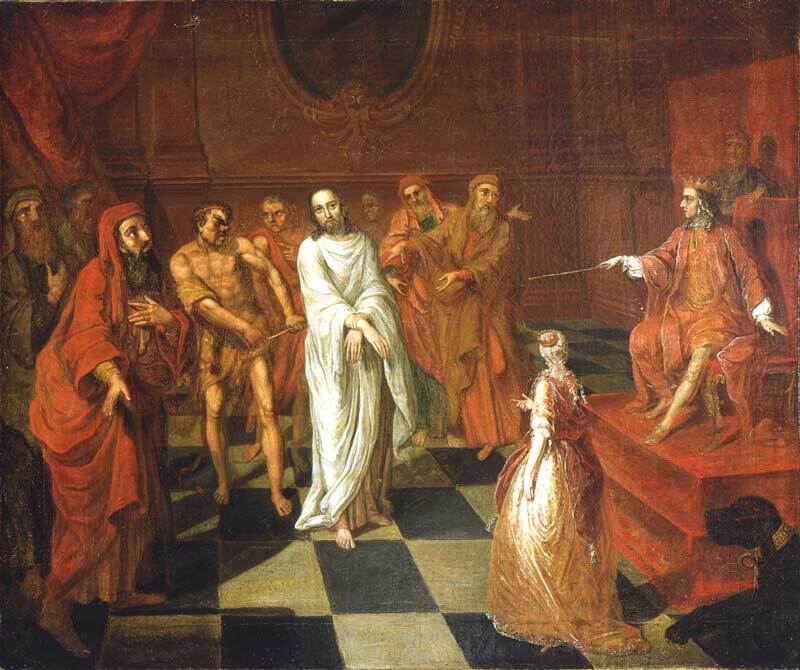
Colored oil on canvas painting of "Christ Before Herod" or "Jesus before Herod" (also sometimes called "Christ before Pilate"). Illustrates the Bible passage, Luke 23:8-10.
Jesus is brought before King Herod, who questions him. Queen Herodias, dressed in fine clothing, looks on from the foot the throne.
This is one of four paintings Haidt made showing the events of Passion Week for the Saal of the single sisters' house in of Nazareth. MHS has two others from the set "The Betrayal of Christ" and "Christ before the Mob".
Excerpt from 1972 Berkeley University Art Museum catalog entry by Jane Dillenberger:
"Despite the richness of detail, the figure of Christ explicitly dominates the scene, an effect Haidt achieved by central placement, the white garments, and the quietude of Christ's mien and posture contrasted with the gesticulating crowd. This painting, dating from about 1765, originally belonged to the Moravian Settlement in Hope, New Jersey. Contemporary diaries reveal that the emphasis on Christ's blood and wounds was not so intense as formerly."
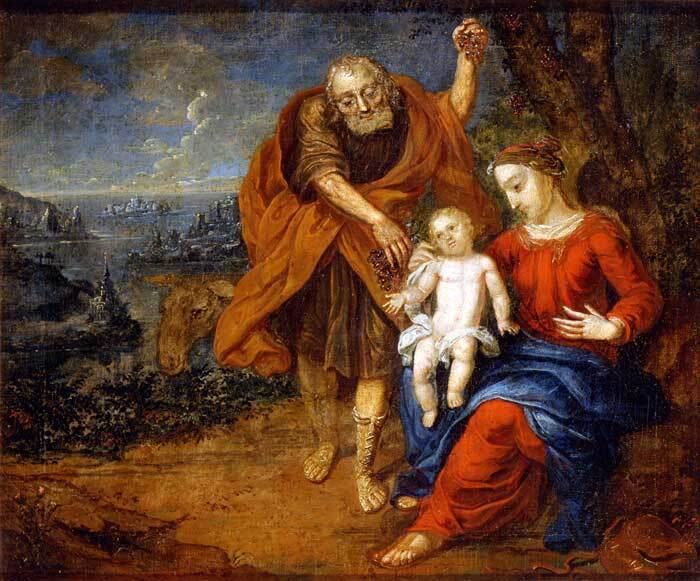
Colored oil painting on canvas of Jesus, Mary, and Joseph seated by the roadside, eating grapes that Joseph has just pulled from a vine hanging overhead.
Description from 1982 exhibition by Charlene Engel:
"In this delightful, small painting the blue glazing, the watery landscape and the cloud-filled sky are reminiscent of the work of such landscapists as Joachim Patinir (c. 1475-1524). An elderly Joseph offers grapes, symbolic of Christ's sacrificial blood, to the child on his mother's knee. The head of Mary's donkey peers out from behind Joseph in the middle ground of the painting."